
Microsoft Sentinel has evolved from a cloud-native SIEM into a modern security data lake platform that enables organizations to ingest, retain, and analyze massive volumes of log data without compromising on cost or coverage. Traditional SIEMs forced security teams to make painful tradeoffs – either limit logging and retention (leaving blind spots) or pay exorbitant costs to store everything.
At Microsoft Ignite 2025, it became evident that Microsoft Sentinel’s new security data lake is now central to the organization’s security data strategy. Security teams are facing an overwhelming increase in telemetry from cloud platforms, applications, endpoints, and hybrid environments—resulting in more data than ever before. This increase in volume makes it crucial to achieve a balance between comprehensive visibility and cost-efficiency while maintaining high data quality for effective threat hunting and compliance. Microsoft’s solution to this challenge is the Sentinel data lake, which offers a scalable, AI-ready foundation for unifying and analyzing security data.
Table of Contents
Why the Sentinel data lake, and Why Now?
Microsoft designed the Sentinel data lake for this reality: it supports open data formats, offers native cloud scalability, and provides long-term retention of security logs – all closely aligned with Microsoft’s broader security architecture and ecosystem. These capabilities form the foundation for modern SOC operations and set the stage for where Microsoft is heading in 2026, with more unified data layers, advanced analytics, and AI-driven security workflows.
However, making the most of this new model isn’t automatic. It requires careful planning of what data to ingest, maintaining consistency and quality across diverse log sources, and architecting your environment to fully leverage the lake’s capabilities. In practice, SOC teams must rethink their data pipelines and governance so that clean, well-structured data fuels those AI-driven workflows effectively.
In a recent blog post, we explored how a unified telemetry pipeline like VirtualMetric DataStream can help achieve this by filtering, enriching, and routing logs – ensuring only meaningful data goes into Sentinel while offloading less critical telemetry to cost-effective storage such as the Sentinel data lake.
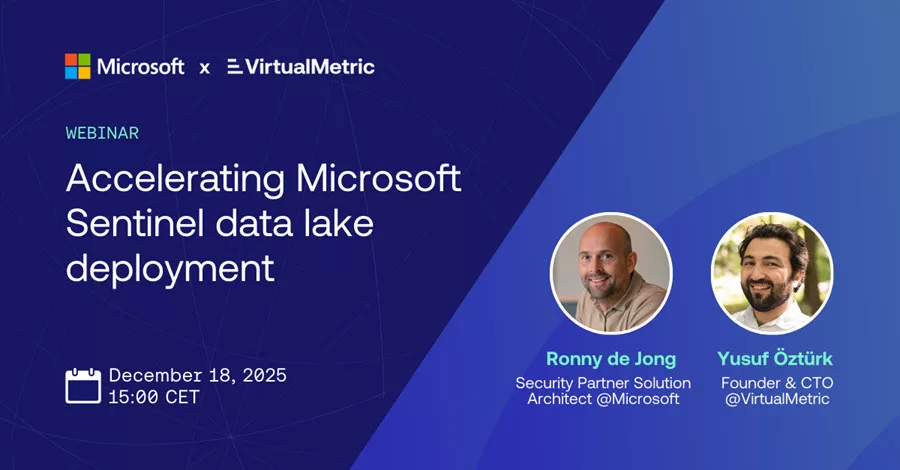
To help organizations prepare for this shift, Microsoft and VirtualMetric are hosting a joint webinar titled “Accelerating Microsoft Sentinel data lake Deployment.” This 45-minute session on December 18, 2025, brings together experts from both companies to share what security operations teams and engineers need to do now to accelerate their Sentinel data lake adoption and maximize its value. The webinar will feature Ronny de Jong (Security Partner Solution Architect at Microsoft) and Yusuf Öztürk (Founder & CTO of VirtualMetric) – both former Microsoft MVPs with deep expertise in security data architecture – who will offer insights from Microsoft’s vision and real-world best practices for managing security telemetry at scale.
Webinar Details
- Date & Time: December 18, 2025 — 15:00–15:45 CET (45-minute live session + Q&A)
- Speakers: Ronny de Jong (Microsoft) and Yusuf Öztürk (VirtualMetric)
- Format: Online (Zoom webinar) – open to security professionals worldwide
- Registration: Register here to reserve your spot (no cost)
If you’re looking to align your SOC with Microsoft’s evolving data strategy, this session will give you practical clarity and a clear roadmap you can start implementing immediately. VirtualMetric DataStream is your fastest path to the Microsoft Sentinel data lake and Microsoft Security Copilot, making it easier to operationalize clean, structured data for AI-driven security workflows.
What You’ll Learn
By attending this technical webinar, you’ll gain actionable insights into:
- Microsoft’s vision for the Sentinel data lake and how it fits into the 2026 security architecture.
- Key planning considerations and fast-tracking your Sentinel data lake adoption.
- Best practices to ensure data quality, consistency, and usability across diverse log sources.
- Strategies to expand visibility (threat coverage) while maintaining predictable cost levels.
- Practical examples and real-world use cases that help SOC teams get more value from Sentinel sooner.
In short, this event is ideal for Security Engineers, Security Architects, SOC Analysts/Managers, and anyone evaluating or planning a Microsoft Sentinel data lake deployment. You’ll come away with a clearer understanding of Microsoft’s data lake strategy and concrete steps to optimize your own security data pipelines and workflows.
Don’t miss this opportunity to stay ahead of the curve as Microsoft Sentinel evolves as a platform. Register now to learn how to accelerate your Sentinel data lake adoption and unlock more value from your security data.
__
Thank you for reading our blog.
Please let us know in the comments section below if you have any questions or feedback.
-Charbel Nemnom-
