Updated – 06/08/2026 – I took the AI-500 exam and documented my experience and takeaways in this section in case it helps others preparing for it. Good luck!
Updated – 28/07/2026 – I am taking the AI-500 beta exam in early August 2026. I will document my experience and takeaways in the AI-500 Exam Experience & Takeaways section below to help others preparing for it. Good luck!
Are you preparing for the new Exam AI-500: Designing and Implementing Multi-Agent AI Solutions? Microsoft has introduced this exam as part of the brand-new Microsoft Certified: Multi-Agent AI Solutions Expert certification, the first expert-level credential in Microsoft’s AI portfolio dedicated entirely to production-grade, multi-agent systems.
AI engineering is changing fast. Two years ago, building an “AI solution” on Azure mostly meant calling a model, grounding it with retrieval-augmented generation (RAG), and shipping a chat interface. Today, the conversation has moved to fleets of agents: agents that plan, call tools, hand off to other agents, share memory, escalate to humans, and run continuously in production under real governance, real budgets, and real service-level agreements.
That shift is exactly what Exam AI-500 validates. It is not a “can you build an agent” exam; that is AI-103. AI-500 asks whether you can architect, build, secure, govern, deploy, monitor, and optimize a system of agents that a business can actually depend on.
In this AI-500 exam study guide, I cover everything you need to know to prepare for and pass the exam, including a full breakdown of the skills measured, the official Microsoft Learn learning paths, Microsoft documentation organized by exam domain, practical exam scenarios, and my personal exam tips. I am taking the beta exam in early August 2026 and will document my first-hand experience and takeaways in the AI-500 Exam Experience & Takeaways section below.
Table of Contents
Exam AI-500 Overview
The official exam title is: AI-500: Designing and Implementing Multi-Agent AI Solutions.
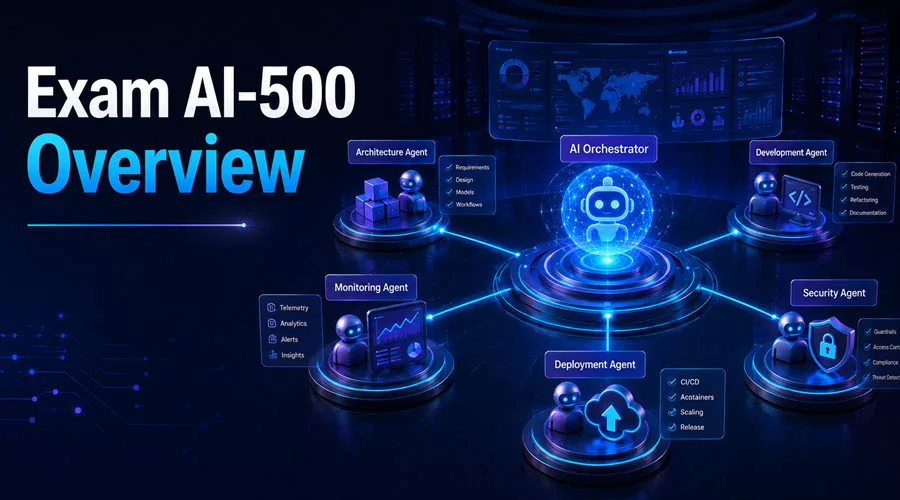
As a candidate for this certification, you’re an expert-level practitioner with subject matter expertise in designing, building, and optimizing scalable, production-ready, multi-agent AI systems and workflows. You manage the development from design to production.
You work closely with developers, machine learning engineers, platform engineers, data scientists, and business stakeholders to translate complex requirements into production-ready, multi-agent solutions.
For this exam, you should have experience developing AI and machine learning, deploying agentic systems in production environments, and orchestrating agent logic using Microsoft Foundry. You should also be proficient in Python.
Additionally, you need experience developing solutions that include Azure compute, network, storage, and data services. You should be familiar with open-source frameworks and standards, including Microsoft Agent Framework, Model Context Protocol (MCP), retrieval-augmented generation (RAG), and LangGraph.
The passing score is 700 out of 1000. At the time of writing, the exam is only available in English. If the exam is not available in your preferred language, you can request an additional 30 minutes to complete it.
Microsoft does not publish the exam duration on the exam details page while an exam is in beta. Based on comparable expert-level exams that I took, plan for roughly 100–120 minutes of actual exam time inside a longer total appointment that also covers the NDA, pre-exam survey, and post-exam feedback. I will confirm the exact timing and question count after I sit the exam.
At the time of writing, this exam is in beta, and there is currently no Practice Assessment available. Microsoft notes that Practice Assessments are usually available within eight weeks after an exam is out of beta and generally available.
The good news is that Microsoft already has four dedicated Microsoft Learn learning paths for the AI-500 published (more on this below), plus an instructor-led course (AI-500T00) scheduled to become available on 30 September 2026. That is a meaningful advantage; use it.
Please note that if you’re planning to take the beta exam, it is not scored immediately because Microsoft gathers data on the quality of the questions and the exam. Beta rescoring begins once the exam goes live, with final results released approximately 10 days later.
The Multi-Agent AI Solutions Expert Certification Path
This is an expert-level certification with a hard prerequisite, which makes it different from most of the exams I have covered on this blog. You cannot earn it by passing AI-500 alone. To become a Microsoft Certified: Multi-Agent AI Solutions Expert, you must:
- Complete one prerequisite – earn the Microsoft Certified: Azure AI Apps and Agents Developer Associate certification by passing Exam AI-103: Developing AI Apps and Agents on Azure.
- Take one exam – pass Exam AI-500: Designing and Implementing Multi-Agent AI Solutions.
- Earn the certification – Microsoft Certified: Multi-Agent AI Solutions Expert.
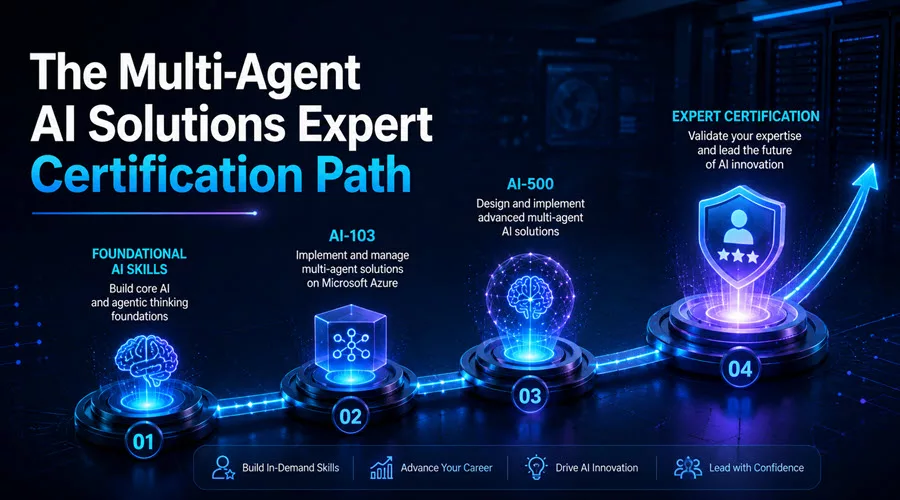
An important practical note: you can take AI-500 before you hold AI-103. The prerequisite is enforced when the certification is awarded, not when the exam is scheduled. If you pass AI-500 first, the expert certification is granted once the AI-103 prerequisite is also satisfied. This matters for the beta window, because the discounted beta seats will not wait for you to finish AI-103 first.
The job roles Microsoft associates with this certification are AI Engineer, AI Edge Engineer, Developer, and Solution Architect.
Like all Microsoft associate, expert, and specialty certifications, this one expires annually and is renewed for free through an online assessment on Microsoft Learn.
How AI-500 Extends AI-103
Understanding the boundary between the two exams is the single most useful thing you can do when planning your study time. AI-103 gives you the foundational Microsoft Foundry and agent development skills; AI-500 extends those skills into advanced multi-agent solution design, orchestration, governance, and optimization.
For reference, here is what AI-103 measures:
| AI-103 Skill Area | Weight |
|---|---|
| Plan and manage an Azure AI solution | 25–30% |
| Implement generative AI and agentic solutions | 30–35% |
| Implement computer vision solutions | 10–15% |
| Implement text analysis solutions | 10–15% |
| Implement information extraction solutions | 10–15% |
Notice what happens in AI-500: the computer vision, text analysis, and information extraction domains disappear entirely. That is roughly 30–45% of AI-103 that has no equivalent in AI-500. In their place, AI-500 goes far deeper on the agentic parts.
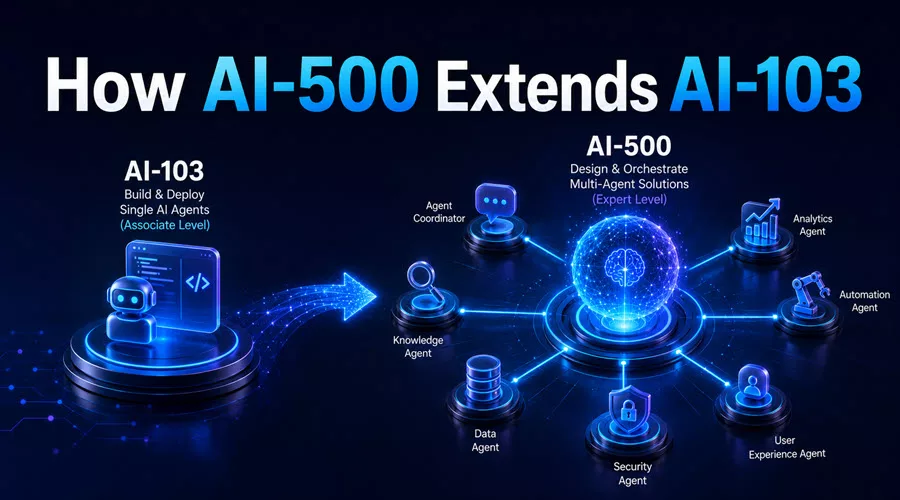
The clearest way to see the shift is illustrated in the following table:
| Topic | AI-103 (Associate) | AI-500 (Expert) |
|---|---|---|
| Agents | Build an agent with tools, memory, and function calling | Architect a system of agents with personas, scopes, autonomy levels, and boundaries |
| Orchestration | One bullet: “Implement orchestrated multi-agent solutions” | Hub-and-spoke, sequential, parallel, peer-to-peer, orchestrator-subagent, agent spawning, batching, concurrency |
| Communication | Agent tools and connectors | A2A protocol, MCP servers and clients, protocol selection between agents and components |
| Memory | Conversation memory | Multi-tier state: session state, shared team state, long-term semantic memory, lifecycle and tenant isolation |
| RAG | Implement RAG in an application | Multi-agent RAG: chunking, embedding quality, retrieval precision, knowledge routing across indexes |
| Safety | Configure content filters and guardrails | Multi-intervention guardrails across user input, tool call, tool response, and output; custom domain guardrails; AI Red Teaming Agent |
| Monitoring | Set up tracing and token analytics | Cross-service trace correlation, agent replay, behavioral drift detection, automated remediation, chargeback |
| Deployment | Integrate Foundry projects with CI/CD | DTAP, blue/green, canary, rollback strategies, infrastructure-as-code, automated evaluations as release gates |
If you hold AI-103 and stop there, the areas most likely to catch you out on AI-500 are orchestration patterns, A2A and MCP as first-class architectural choices, multi-tier memory and state design, observability and cost governance, and release engineering for agents. Plan your study time accordingly.
Exam AI-500 Target Audience
The AI-500 exam is intended for expert-level AI practitioners who take multi-agent systems all the way from design to production. This includes professionals who work with:
• Microsoft Foundry and Foundry Agent Service
• Microsoft Agent Framework
• Model Context Protocol (MCP)
• Agent2Agent (A2A) protocol
• LangChain and LangGraph
• Hugging Face Transformers
• Azure AI Search (hybrid, semantic, and agentic retrieval)
• Azure Cosmos DB and Azure Managed Redis
• Azure Functions, Azure Logic Apps, and Azure API Management
• Azure Monitor and Application Insights (OpenTelemetry)
• Microsoft Entra ID, agent identity, and Azure RBAC
• Azure Key Vault
• Azure AI Content Safety and Foundry guardrails
• GitHub Actions and infrastructure-as-code
• Power Automate and Microsoft Teams (human-in-the-loop approvals)
• Python
In this role, you collaborate with developers, machine learning engineers, platform engineers, data scientists, and business stakeholders to translate complex requirements into production-ready, multi-agent solutions.
You are a good candidate for this exam if you:
• Decompose business goals into workflows, agents, and tools.
• Choose and implement multi-agent orchestration patterns.
• Design memory, state, and knowledge architectures that span multiple agents.
• Build and secure MCP servers and tool ecosystems.
• Implement guardrails, evaluations, and red teaming for agentic systems.
• Instrument distributed tracing and monitoring across agent boundaries.
• Control token usage, latency, and cost across an agent fleet.
• Deploy agents through CI/CD with rollback and progressive release strategies.
Exam AI-500 Prerequisites
Unlike most role-based exams, AI-500 has a formal certification prerequisite: the Microsoft Certified: Azure AI Apps and Agents Developer Associate certification (Exam AI-103). See the AI-103 study guide for its full objective list.
Beyond that formal requirement, this is a genuinely expert-level exam. Before taking it, you should have practical experience with:
• Python, including async patterns and REST API consumption
• Developing AI and machine learning solutions
• Deploying agentic systems in production environments
• Orchestrating agent logic using Microsoft Foundry
• Microsoft Foundry Agent Service and Microsoft Agent Framework
• Foundational orchestration patterns (sequential, concurrent, group chat, handoff)
• The A2A protocol and connecting to a remote agent
• Consuming MCP tools and custom function tools
• Classic RAG retrieval with Azure AI Search (hybrid search, semantic ranking)
• System prompt design for agent persona and behavior control
• Azure compute, network, storage, and data services
• OpenTelemetry instrumentation and Azure Monitor / Log Analytics
• GitHub Actions for CI/CD pipeline design
• Azure Key Vault, managed identities, and Azure RBAC
• Responsible AI principles and Azure AI Content Safety guardrails
Microsoft’s own learning paths also list AI-300 “Operationalize generative AI applications” (or equivalent experience) as a prerequisite for the deploy/govern and monitor/evaluate paths. If your background is heavier on building than on operating, that is where to invest first.
Exam AI-500 Preparation
How do you prepare for the AI-500 exam?
Because this exam covers the full lifecycle of a multi-agent solution, your preparation should span architecture, development, operations, and governance — not just code.
You should be comfortable answering questions such as:
• How do you decompose a business goal into workflows, agents, subagents, and tools?
• When do you choose hub-and-spoke over sequential, parallel, peer-to-peer, or orchestrator-subagent orchestration?
• How do you specify agent personas, scopes, boundaries, and autonomy levels?
• How do you decide between A2A and MCP for a given integration?
• How do you design short-term versus long-term memory, and where does each live?
• How do you implement context compaction without causing sliding-window amnesia or summary drift?
• How do you build an MCP server on Azure Functions, Logic Apps, or API Management?
• How do you validate tool results and design fallback behavior when a tool fails?
• How do you implement human-in-the-loop approvals, overrides, and edge case handling?
• How do you design prompt caching, semantic caching, and response caching?
• How do you evaluate a multi-agent chain with LLM-as-a-judge, and how do you calibrate it?
• How do you correlate traces across agent service boundaries?
• How do you detect behavioral drift and quality regression, and remediate automatically?
• How do you scope per-agent identity and prevent lateral movement in a Zero Trust design?
• How do you implement guardrails at user input, tool call, tool response, and output?
• How do you use the AI Red Teaming Agent as a shift-left security practice?
• How do you choose between DTAP, blue/green, and canary release methodologies for agents?
• How do you gate a release on automated evaluations in CI/CD?
• How do you monitor and charge back token cost across an agent fleet?
The exam objectives are detailed and heavily worded around design and implement, so structure your preparation around the official skills measured, and make sure you can both choose an approach and build it.
Microsoft also notes that the bullets under each skill area illustrate how the skill is assessed, and related topics may also be covered on the exam. Most questions cover generally available (GA) features, but the exam may include questions on preview features if those features are commonly used. This matters more on AI-500 than on almost any other exam — a large amount of the agentic surface area in Foundry (agent guardrails, A2A endpoints, memory and web search tools, agentic retrieval) is in preview and moving quickly.
Skills Measured on The AI-500 Exam
The AI-500 exam measures four main skill areas.
| Skill Area | Weight |
|---|---|
| Architect multi-agent solutions | 15–20% |
| Develop multi-agent solutions in Azure | 30–35% |
| Evaluate, optimize, and monitor multi-agent solutions | 20–25% |
| Secure, govern, and deploy multi-agent solutions | 20–25% |
The distribution tells you a lot. Develop multi-agent solutions in Azure is the dominant section at 30–35%, roughly a third of the exam, and it is the most hands-on domain by far. But the two operational domains — evaluate/optimize/monitor and secure/govern/deploy — together account for 40–50% of the exam. That is the defining characteristic of AI-500: half of it is about running agents, not writing them.
If you come from a developer background, that operational half is where you are most likely to lose points.
Architect multi-agent solutions — 15–20%
This is the smallest section by weight but it sets up everything else. Expect design and “choose the best approach” questions rather than syntax.
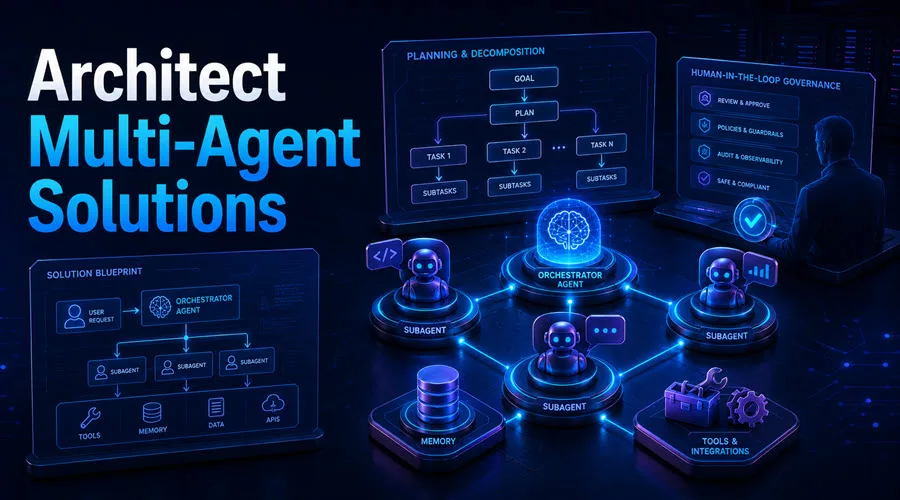
Design logical architecture for multi-agent solutions
You should know how to:
• Decompose goals and objectives into workflows, agents, and tools
• Design workflows, including agents, subagents, control loops, and human-in-the-loop
• Specify agent personas, scopes, boundaries, autonomy levels, and behavioral guidelines
• Specify tool scopes, permission boundaries, and authentication methods
• Specify appropriate protocols for communication, including between multiple agents and between agents and other components
• Design controls and functionality to support human-AI experience (HAX) and to adhere to responsible AI principles
• Design short-term and long-term memory architectures, including context sharing
• Match task demands to model family capacities
Specify technology components to include in a multi-agent solution
You should know how to:
• Specify integration components to coordinate agent-to-agent communication, agent-to-tool interactions, and agent-to-knowledge-source routing across a multi-agent production system
• Specify components for Zero Trust multi-agent solutions, including per-agent identity scoping, lateral movement prevention, and compliance control mapping for regulated deployments
• Specify multi-tier state persistence components that address session state, shared team state, and long-term semantic memory with lifecycle and tenant-isolation policies
• Specify compute components for multi-agent solutions that meet scalability, reliability, operational efficiency, security, and cost requirements
• Specify observability components, including cross-service trace correlation, structured logging of agent reasoning paths, and agent replay capture for reproducible debugging
• Specify monitoring components, including cross-agent coordination tracking, behavioral drift and quality regression detection, and automated remediation for agent failure patterns
• Specify developer tools and environment to support the Software Development Lifecycle (SDLC), including dev containers, Visual Studio Code extensions, command-line interface (CLI), dependency management, and AI instructions
Two things stand out here. First, “match task demands to model family capacities” — expect questions about routing simple tasks to small or cheap models and reserving frontier models for hard reasoning. Second, the developer tooling bullet is unusual for a Microsoft exam; dev containers, VS Code extensions, the Azure Developer CLI, dependency management, and AI instruction files are explicitly in scope.
Develop multi-agent solutions in Azure — 30–35%
This is the largest section of the exam and the most implementation-focused. Expect code, SDK, and configuration questions.
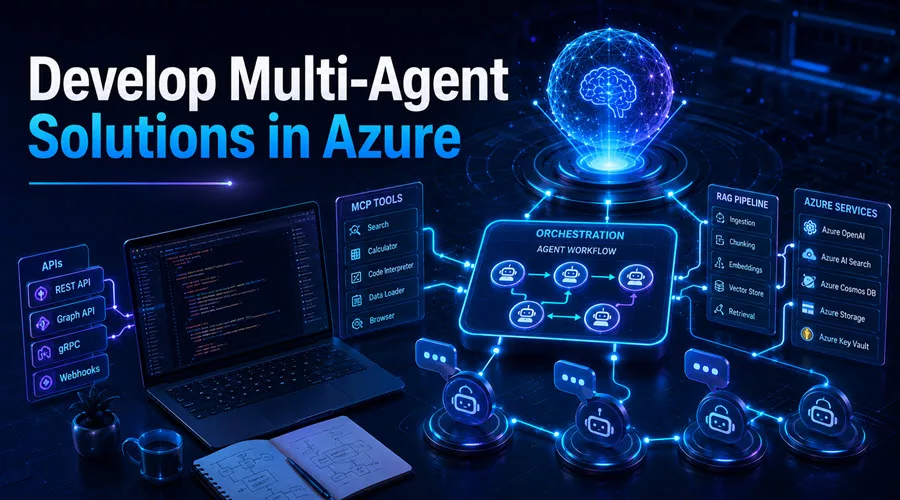
Design and implement advanced prompt engineering strategies in multi-agent solutions
You should know how to:
• Design and implement advanced prompt engineering techniques, including examples, dynamic context injection, defensive guidelines, and prompt lifecycle management
• Design and implement context-aware multi-agent behaviors
• Design and implement a strategy for fine-tuning agents and models, including data and frequency
Design and implement agent memory, context management, and knowledge integration
You should know how to:
• Design and implement context management in single agents and between agents, including context accumulation, retrieval, injection, and compaction
• Design and implement single-agent and multi-agent memory strategies, including security, compliance, lifecycle, storage, and session management
• Design and implement a multi-agent RAG architecture, including chunking, embedding quality, and retrieval precision
• Design and implement knowledge integration for multi-agent consumption, including search, RAG, MCP-available sources, and semantic search
Build and integrate tool ecosystems
You should know how to:
• Integrate external resources, including function calling, specified tool use, and dynamic tool use
• Design and build MCP servers and clients, including Azure Functions, Azure Logic Apps, and Azure API Management
• Design tool error-handling and fallback mechanisms
• Implement tool result validation and quality checks
Implement multi-agent orchestration
You should know how to:
• Implement multi-agent orchestration patterns, including hub-and-spoke, sequential, parallel, peer-to-peer, and orchestrator-subagent
• Implement human-in-the-loop processes, including approval workflows, overrides, and edge case handling
• Design and implement a caching strategy, including prompt caching, semantic caching, and response caching
• Implement scaling and control of multi-agent spawning, batching, and concurrent execution
• Integrate existing agents into a multi-agent solution securely by using Agent2Agent (A2A) and/or MCP
• Implement multi-agent orchestration frameworks, including Agent Framework, LangChain, and LangGraph
• Implement advanced multi-agent capabilities by using Hugging Face Transformers
• Design middleware for reusable capabilities across the solution, including logging, authorization, and exception handling
Note carefully that LangChain, LangGraph, and Hugging Face Transformers are explicitly named in the objectives. This is not a Microsoft-only exam. Know how Agent Framework compares to LangGraph, and be prepared for questions where the correct answer is an open-source framework rather than a first-party service.
Also note middleware as a design concern. Agent Framework’s middleware model (intercepting agent actions for logging, authorization, and exception handling) is directly relevant.
Evaluate, optimize, and monitor multi-agent solutions — 20–25%
This section is about proving your system works and keeping it working.
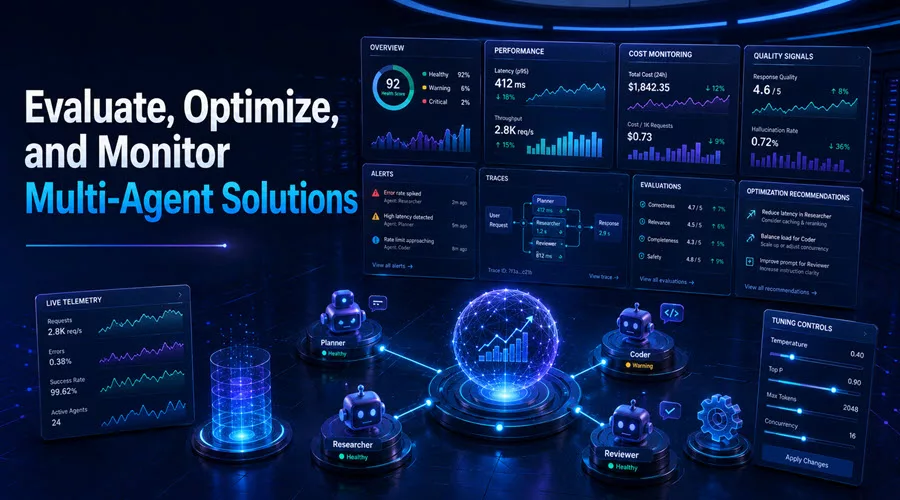
Design and implement evaluation and validation strategies for multi-agent solutions
You should know how to:
• Design and implement a human review process to evaluate solutions in Foundry
• Design and implement evaluations for memory, knowledge, tools, and prompts
Optimize prompt and model performance for multi-agent solutions
You should know how to:
• Optimize task duration, including parallelism and rate limits
• Diagnose context window issues, including sliding-window amnesia, summary drift, vector-only recall, and entity continuity issues
• Design and implement continuous improvement, including large language model–as-a-judge (LLM-as-a-judge) frameworks, synthetic data generation, semantic optimization loops, and user feedback loops
Design and implement observability and monitoring for multi-agent solutions
You should know how to:
• Design a strategy for monitoring reliability, including agent health, workflow failures, trace correlation, drift detection, quality regression, and remediation
• Design a strategy for monitoring solution and platform availability, performance, reliability, and service-level agreement adherence
• Design and implement a strategy for optimizing token usage, including token limits, loop controls, and tool calls
• Design a strategy for monitoring and managing cost, including usage, quotas, allocations, and chargebacks
• Implement tracing in Foundry, including tokens, prompts, correlation IDs, alerting, and execution tracking
The context window diagnosis bullet is the most distinctive on the whole blueprint. Learn these four failure modes by name, because they are almost certainly written into scenario questions:
• Sliding-window amnesia — the agent silently drops early context as the window fills, losing constraints stated at the start of a task.
• Summary drift — repeated summarization compounds small distortions until the summary no longer reflects the original facts.
• Vector-only recall — retrieval relies purely on embedding similarity, so exact identifiers, names, and rare terms are missed (the fix is hybrid search).
• Entity continuity issues — the agent loses track of which entity it is discussing across turns or across a handoff between agents.
Secure, govern, and deploy multi-agent solutions — 20–25%
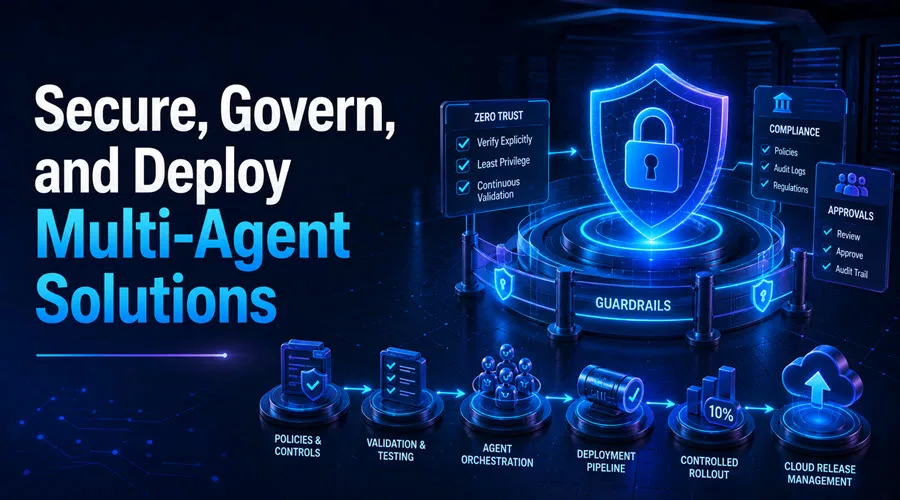
Design and implement security for multi-agent solutions
You should know how to:
• Specify and implement resource access, including identity-based access, network boundaries, access control policies, and role-based access control (RBAC)
• Design and implement authentication flows in a multi-agent solution, including user impersonation, on-behalf-of, API keys, and OAuth 2.0
• Design the secrets management and retrieval approach for multi-agent solutions by using Azure Key Vault, including secrets, certificates, key rotation, role-based access to secrets, and encryption
• Implement shift-left security principles, including the AI Red Teaming Agent in Foundry
Design and implement guardrails for multi-agent solutions
You should know how to:
• Design and implement a multi-intervention guardrail strategy covering user inputs, tool calls, tool responses, and outputs
• Design and implement custom guardrails for domain-specific constraints
• Design guardrail testing and validation, including using synthetic data
Deploy multi-agent solutions to Azure
You should know how to:
• Choose a release methodology, including Development-Test-Acceptance-Production (DTAP), blue/green, and canary
• Design and implement multi-environment release strategies, including rollback strategies, release management, and rollout
• Design and implement a strategy for testing, including unit tests, regression tests, integration tests, and automated evaluations
• Specify continuous integration and continuous deployment (CI/CD) requirements for integration and release, including infrastructure-as-code deployments and testing
The four guardrail intervention points are worth memorizing exactly, because they are the structural core of this domain: user input, tool call, tool response, and output. Tool call and tool response apply to agents only, not to bare models. Also know that in Foundry, an agent’s guardrail fully overrides the guardrail of its underlying model deployment — that inheritance rule is precisely the kind of detail an exam question is built on.
Exam AI-500 Learning Path and Study Resources
As mentioned earlier, Microsoft has already published four dedicated learning paths for AI-500, comprising 17 modules in total. All four are rated under the Advanced level. These are your primary study resource — work through all of them.
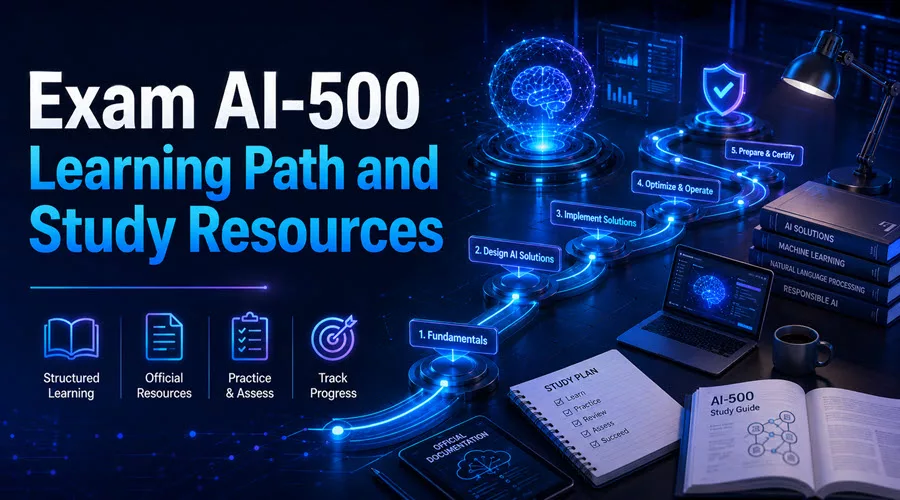
Learning Path 1: Architect production-grade multi-agent AI solutions in Azure (4 modules)
• Design stateful agentic loops with Microsoft Foundry Agent Service — run-status handling, context accumulation, reflection and planning cycles, session state persistence, fork-based session patterns, and migrating Agents v1 workloads to the Agents v2 Responses API
• Implement advanced multi-agent orchestration patterns in Microsoft Foundry — hub-and-spoke architectures, parallel agent spawning with synchronization and partial failure recovery, hierarchical supervisor patterns, and trade-offs across Semantic Kernel, LangGraph, AutoGen, and CrewAI
• Apply task decomposition and agent collaboration strategies in Microsoft Foundry — prompt chaining, LLM-driven adaptive decomposition with meta-agent planners, agent handoff protocols, and balancing decomposition granularity against coordination overhead
• Design enterprise-scale agent communication with A2A in Azure — agent discovery registries with capability-based routing, shared state with Azure Cosmos DB and Azure Managed Redis, context isolation for multitenant deployments, and conflict detection and resolution
Learning Path 2: Build production-grade multi-agent capabilities with Microsoft Foundry (4 modules)
• Design advanced prompting strategies for production AI agents — multiturn reasoning with dynamic context injection, layered prompt injection defenses, system prompt frameworks for persona and constraint control, and prompt versioning and optimization workflows
• Build enterprise-grade tool ecosystems with MCP and Microsoft Foundry — custom MCP servers with authentication and production error handling, dynamic tool selection and routing, tool result validation and fallback pipelines, and tool governance with dependency management and versioning
• Implement advanced RAG pipelines with Azure AI Search and Microsoft Foundry — hybrid search combining BM25 keyword and semantic vector retrieval, reranking strategies, dynamic knowledge source routing across multiple indexes, and chunking and embedding optimization
• Design multi-agent memory architectures with Azure Cosmos DB — semantic memory with vector storage across sessions, context window optimization balancing richness against cost and latency, and memory expiration and pruning policies
Learning Path 3: Deploy and govern enterprise agentic AI solutions on Azure (4 modules)
• Implement CI/CD pipelines for multi-agent systems with GitHub Actions — coordinated deployment pipelines with agent version compatibility validation, progressive deployment including canary releases, multi-environment deployments with infrastructure as code, and automated rollback triggered by quality regression detection
• Secure multi-agent systems with Azure zero-trust architecture — per-agent managed identities with least privilege, authentication flows (managed identity, on-behalf-of, user-delegated, key-based), secrets lifecycle with Azure Key Vault including rotation and customer-managed keys, network controls to prevent lateral movement, multitenant data isolation, and compliance controls
• Scale responsible AI governance with Azure AI Content Safety and Microsoft Foundry — fairness and bias monitoring for agent decision chains, transparency and explainability for multi-agent outputs, privacy protection for multi-agent data pipelines, and audit trail frameworks
• Govern the enterprise agent lifecycle in Microsoft Foundry — agent versioning and approval workflows, usage quotas and cost allocation models, change management and behavioral risk assessment, and agent retirement workflows
Learning Path 4: Monitor, evaluate, and operate multi-agent AI solutions in Azure (5 modules)
• Implement distributed observability for multi-agent solutions with OpenTelemetry — distributed tracing that propagates correlation context across agent service boundaries, structured logging of agent decision paths, telemetry aggregation pipelines, and anomaly detection for abnormal agent behavior
• Design evaluation frameworks for multi-agent solutions with Microsoft Foundry — success metrics capturing coordination quality and system-level outcomes, calibrated LLM-as-judge patterns for multi-agent chain assessment, synthetic test datasets exercising agent collaboration, and regression testing pipelines for behavioral drift detection
• Optimize multi-agent performance and cost in Microsoft Foundry — model routing strategies across agent ecosystems, multi-level caching architectures, token usage and context management optimization across agent chains, and quality-cost-latency trade-off analysis
• Design human-in-the-loop approval workflows with Power Automate and Microsoft Teams — confidence-threshold escalation, asynchronous approval workflows for high-stakes actions, human feedback collection and active learning pipelines, and audit workflows for regulated environments
• Debug and respond to production multi-agent incidents in Azure — agent replay to reproduce complex failures, structured root cause analysis, automated detection and remediation for common failure patterns, and incident response and post-mortem processes adapted to AI agent systems
You can view the full instructor-led format course outline here. However, you should use the official Microsoft study guide as your primary and authoritative reference.
AI-500 Microsoft Documentation by Exam Domain
Beyond the learning paths and to prepare effectively, I also curated the following official Microsoft documentation, organized by exam domain, to help you study so you can read and learn more about each topic:
Architect multi-agent solutions
• Microsoft Foundry documentation
• What is Microsoft Foundry Agent Service?
• Microsoft Agent Framework overview
• Agent Framework workflows
• Build a multiple-agent workflow automation solution by using Microsoft Agent Framework
• Hosted agents in Foundry Agent Service
• Agent development lifecycle
• Enable incoming A2A on a Foundry agent
• Agent identity concepts in Microsoft Foundry
• Azure Cosmos DB integrated vector database
• Azure Managed Redis overview
• Zero Trust guidance
• Azure Developer CLI (azd) overview
Develop multi-agent solutions in Azure
• Foundry tool catalog
• Model Context Protocol tool in Foundry Agent Service
• Toolbox: curate and version a tool set
• Model context protocol bindings for Azure Functions
• MCP server support in Azure API Management
• Expose a REST API as an MCP server in API Management
• RAG and generative AI with Azure AI Search
• Agentic retrieval in Azure AI Search
• Hybrid search overview
• Semantic ranking in Azure AI Search
• What is Foundry IQ?
• Agent optimizer overview
Evaluate, optimize, and monitor multi-agent solutions
• Observability in generative AI
• Trace agents in Foundry
• Monitor agents dashboard
• Built-in evaluators reference
• Custom evaluators
• Enable Azure Monitor OpenTelemetry
Secure, govern, and deploy multi-agent solutions
• Guardrails and controls overview in Microsoft Foundry
• Guardrail intervention points and controls
• Azure AI Content Safety overview
• AI Red Teaming Agent
• Run the AI Red Teaming Agent in the cloud
• Foundry Control Plane overview
• Responsible AI for Microsoft Foundry
• Azure role-based access control in Foundry
• Azure RBAC overview
• Managed identities for Azure resources
• OAuth 2.0 on-behalf-of flow
• Azure Key Vault overview
• Virtual networks for Foundry agents
• Publish an agent as an agent application
• Deploy to Azure with GitHub Actions
• Bicep overview (infrastructure as code)
Because AI-500 is a practical implementation exam, reading alone is not enough. You should get hands-on experience in the Microsoft Foundry portal, the Foundry and Agent Framework SDKs in Python, Azure AI Search, Azure Cosmos DB, Application Insights, and GitHub Actions.
AI-500 Example Exam Scenarios
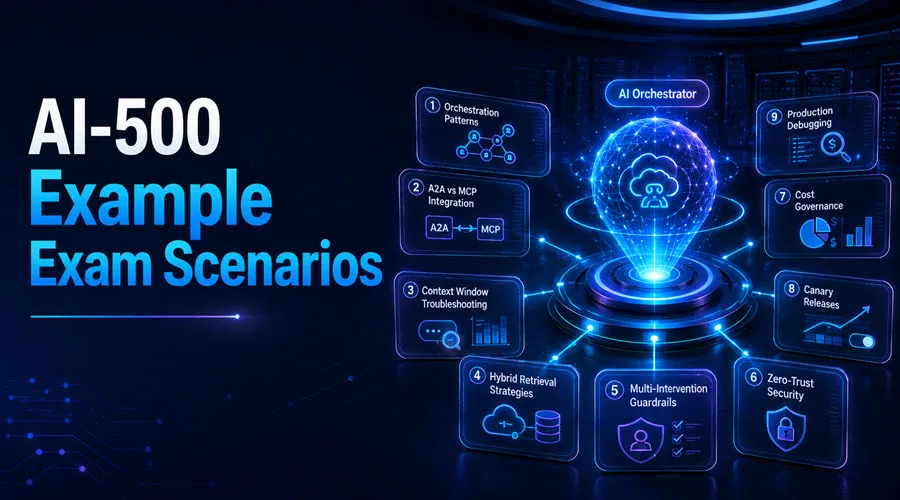
Scenario 1: Choosing an Orchestration Pattern
A claims-processing solution must run intake validation, fraud scoring, and policy lookup, then produce a single decision. Fraud scoring and policy lookup are independent and slow.
Best approach:
• Use an orchestrator-subagent (or hub-and-spoke) pattern with a coordinating agent.
• Run fraud scoring and policy lookup in parallel, then synchronize results.
• Implement partial failure recovery so one failed subagent does not fail the whole run.
• Add a human-in-the-loop approval gate for decisions above a confidence or value threshold.
• Avoid a purely sequential chain here; it serializes two independent calls and doubles latency for no benefit.
Scenario 2: Integrating an Existing Third-Party Agent
Your organization already runs a vendor agent outside Azure. You need your Foundry agents to delegate work to it securely.
Best approach:
• Use the A2A protocol — it is designed for agent-to-agent delegation, whereas MCP is designed for agent-to-tool access.
• Create an A2A connection to the remote endpoint and use the A2A tool from the calling agent.
• Authenticate with Microsoft Entra ID using the agent identity or on-behalf-of the end user; do not use anonymous or key-based access for inbound A2A.
• Assign the least-privilege role to the calling identity on the target project.
• Publish an agent card so the target agent’s capabilities are discoverable.
Scenario 3: Context Window Degradation in Long Sessions
Users report that an agent “forgets” a constraint they stated at the beginning of a long session, and that repeated summaries slowly diverge from the facts.
Best approach:
• Diagnose this as sliding-window amnesia combined with summary drift.
• Pin critical constraints into the system prompt or a persistent instruction layer rather than relying on conversation history.
• Implement structured context compaction rather than naive re-summarization of summaries.
• Persist long-term semantic memory in Azure Cosmos DB with vector storage, and retrieve selectively.
• Add entity tracking so identifiers survive compaction and agent handoffs.
Scenario 4: Retrieval Misses Exact Identifiers
A multi-agent support solution retrieves conceptually related documents but consistently fails to find records by part number or ticket ID.
Best approach:
• Diagnose this as vector-only recall.
• Move to hybrid search combining BM25 keyword matching with vector similarity.
• Apply semantic ranking to re-score the merged result set.
• Revisit chunking so identifiers are not split across chunk boundaries.
• Consider agentic retrieval when queries are complex or conversational and the client is an agent.
Scenario 5: Multi-Intervention Guardrails
A regulated customer requires that an agent be prevented from sending sensitive data to an external tool, and from returning unsafe content to the user.
Best approach:
• Configure guardrail controls at all four intervention points: user input, tool call, tool response, and output.
• Remember that tool call and tool response interventions apply to agents only, not to bare model deployments.
• Assign the guardrail explicitly to the agent — an agent-level guardrail fully overrides the model’s guardrail.
• Add custom controls for domain-specific constraints the built-in risk categories do not cover.
• Validate the configuration with synthetic adversarial data before production.
Scenario 6: Shift-Left Security Testing
You must demonstrate, before deployment, that your agent resists prompt injection hidden in retrieved documents.
Best approach:
• Run the AI Red Teaming Agent with indirect prompt injection (XPIA) attack strategies.
• Target agentic risk categories: prohibited actions, sensitive data leakage, and task adherence — note these are cloud-only.
• Measure Attack Success Rate (ASR) and use it as a release gate.
• Run in a purple environment configured with production-like resources, not in production.
• Layer runtime guardrails and content filters on top; red teaming is detection, not mitigation.
Scenario 7: Zero Trust for an Agent Fleet
Fifty agents access different downstream systems. A compromise of one agent must not grant access to another’s data.
Best approach:
• Give each agent its own agent identity rather than sharing the project identity; publish agents to get distinct identities.
• Assign least-privilege RBAC roles at the narrowest scope (resource, not subscription).
• Use federated credentials and managed identities so no secrets are stored; keep secrets and certificates in Azure Key Vault with rotation.
• Apply network boundaries and private networking to prevent lateral movement.
• Enforce tenant isolation in shared state stores.
• Remember that role assignments do not carry over when an agent is published and receives a new identity.
Scenario 8: Cost and Token Governance
Monthly spend on an agent fleet has tripled, and no one can attribute the increase to a specific team.
Best approach:
• Implement token usage optimization: token limits, loop controls, and constraints on tool call counts.
• Add multi-level caching — prompt caching, semantic caching, and response caching.
• Route simple tasks to smaller models and reserve frontier models for hard reasoning.
• Configure quotas and allocations per project or team, and implement chargeback reporting.
• Correlate cost with traces in Application Insights to identify which agent chain drives spend.
Scenario 9: Safe Release of an Agent Update
You need to roll out a new agent version without risking a quality regression for all users.
Best approach:
• Use a canary release to route a small percentage of traffic to the new version first.
• Gate promotion on automated evaluations, not just unit and integration tests.
• Validate agent version compatibility across the coordinated multi-agent deployment.
• Configure automated rollback triggered by quality regression detection.
• Manage environments and infrastructure with infrastructure-as-code through GitHub Actions.
Scenario 10: Debugging a Production Multi-Agent Failure
An intermittent failure occurs somewhere across five agents, and logs from each service look individually healthy.
Best approach:
• Ensure OpenTelemetry correlation context propagates across agent service boundaries so a single trace spans the whole workflow.
• Use structured logging of agent reasoning paths, not just request/response logs.
• Capture agent replay so the failure can be reproduced deterministically.
• Apply structured root cause analysis across the trace, then automate detection and remediation for that failure pattern.
• Feed the finding back through a post-mortem process adapted to AI system failures.
Schedule Exam AI-500
Once you are ready, you can schedule Exam AI-500 from the official Microsoft Learn exam page.
At the time of writing, Microsoft lists Exam AI-500 as a beta exam. According to the official Microsoft Tech Community announcement, the first 300 people who take Exam AI-500 beta on or before 5 August 2026 can get 80% off by using the discount code AI500Wabash when prompted for payment.
This is not a private access code; seats are offered on a first-come, first-served basis, subject to availability and country restrictions. Please note that this discount is not available in Turkey, Pakistan, India, or China.
If you are planning to use the beta discount, book early. The window closes on 5 August 2026, and 300 seats globally go quickly on a certification this heavily promoted.
Before scheduling, make sure you:
• Read the official Microsoft study guide carefully; we already discussed it here.
• Review all four skills measured areas.
• Complete all four Microsoft Learn learning paths above (17 modules).
• Get hands-on practice in the Microsoft Foundry portal, the Python SDKs, Azure AI Search, Azure Cosmos DB, and GitHub Actions.
• Plan how you will satisfy the AI-103 prerequisite, if you have not already.
• Use the exam sandbox to understand the Microsoft exam experience.
• Confirm the latest exam availability, language, and pricing in your region.
I strongly recommend using a personal Microsoft account when registering for Microsoft certification exams. If you register with an organizational account, your exam records could be impacted if you leave the organization.
Please note that if you’re planning to take the beta exam, it is not scored immediately because Microsoft gathers data on the quality of the questions and the exam.
You can also explore the exam environment by visiting the exam sandbox page.
AI-500 Exam Tips
Here are my recommendations to prepare for and pass the AI-500 exam:
• Do not treat this as “AI-103 plus a bit more.” The vision, text analysis, and information extraction domains are gone, and the agentic domains go far deeper.
• Complete all four learning paths. Unlike other recent beta exams, Microsoft published real training content for AI-500 — that content maps closely to the objectives.
• Learn the orchestration patterns by name: hub-and-spoke, sequential, parallel, peer-to-peer, orchestrator-subagent. Know when each is the right answer and what it costs in latency and coordination overhead.
• Know the difference between A2A and MCP cold. A2A is agent-to-agent delegation; MCP is agent-to-tool access. Questions will make you choose.
• Memorize the four guardrail intervention points and the agent-overrides-model inheritance rule.
• Learn the four context window failure modes by name: sliding-window amnesia, summary drift, vector-only recall, entity continuity.
• Understand agent identity in Microsoft Entra: agent identities, agent identity blueprints, shared project identity versus distinct published identity, and the fact that role assignments do not carry over on publish.
• Be ready for open-source frameworks. LangChain, LangGraph, and Hugging Face Transformers are named in the objectives, and Semantic Kernel, AutoGen, and CrewAI appear in the training content.
• Know the three caching layers: prompt caching, semantic caching, response caching, and when each applies.
• Study hybrid retrieval properly: BM25 plus vectors, semantic ranking, reranking, chunking, and embedding quality.
• Get comfortable with OpenTelemetry trace correlation across service boundaries — this is the backbone of the observability domain.
• Do not skip the cost and governance bullets: quotas, allocations, chargebacks, and token limits are explicitly in scope and are easy marks if you have read them.
• Practice release engineering for agents: DTAP, blue/green, canary, rollback on quality regression, and automated evaluations as CI/CD gates.
• Remember that Foundry’s agentic surface moves fast and much of it is in preview. Check the current documentation rather than relying on what you learned six months ago.
• Use the official skills measured as your final checklist.
The best exam mindset is: think like an engineer who is on call for a fleet of agents. Every question is easier if you ask yourself “what would I need in place to run this safely, observably, and affordably in production?” rather than “how do I make this work once?”
AI-500 Exam Experience & Takeaways
I took the AI-500 beta exam, and here is my honest experience to help you prepare and pass this challenging exam.
Exam Format and Structure
I received 63 questions with 120 minutes (2 hours) of actual exam time. I finished in about 110 minutes, which gives you less than 2 minutes per question. The total exam time shown is 150 minutes (2.5 hours), but this includes the NDA agreement, pre-exam survey, post-exam feedback, and survey — the actual exam clock is 120 minutes.
The question breakdown:
49 standalone questions, including 7 drag-and-drop questions and 6 True/False-type questions, plus 2 case studies (one case study with 5 questions and a second case study with 4 questions), bringing the total to 63 questions. At the time of this writing, there were no performance-based tasks (labs), but this might change in future versions of this exam.
The exam is long, difficult, and confusing. You need to read the questions very carefully because they are tricky. Many questions are scenario-based with detailed context, and the answer choices are closely worded to test your real understanding.
The AI-500 exam is open-book. You have access to Microsoft Learn documentation during the exam, which you can use to double-check answers. However, be careful not to rely on it too much — with under 2 minutes per question, you do not have time to look up every answer. Use it as a safety net for specific syntax or role names, not as a replacement for preparation.
I will share my score results as soon as I receive the final report, later in September 2026, once the exam is out of beta.
What I Actually Saw in the Exam
Here is what I encountered in the exam, along with official Microsoft documentation links for each topic so you can study further:
Microsoft Foundry (Heavy Focus)
This was by far the dominant theme on the exam. Questions spanned the whole platform: project structure, agent runtime, tools, memory, sessions, and role-based access control. If you master Microsoft Foundry architecture, you have covered the majority of this exam.
• What is Microsoft Foundry?
• What is Microsoft Foundry Agent Service?
• Role-based access control for Microsoft Foundry
Agents, Conversations, and Responses
Questions on the core runtime components of Foundry Agent Service and how they fit together, including conversation item types — message items, tool call items, tool output items, and output items. Know what each item type represents and when it appears in a conversation.
• Build with agents, conversations, and responses in Foundry Agent Service
• Quickstart: Use the Responses API
Types of Tools in Foundry Agent Service
Questions on the tool catalog and which tool fits a given requirement.
• Foundry tool catalog
• Model Context Protocol tool in Foundry Agent Service
Hosted Agents and Session Isolation
A specific scenario on isolating hosted agent sessions per user. Understand that each caller sees only their own sessions by default, how the isolation key is derived from the caller’s Microsoft Entra token, and how session management works for hosted agents.
• Isolate hosted agent sessions per user
• Manage hosted agent sessions
• Hosted agents in Foundry Agent Service
• Hosted agent permissions reference
Microsoft Agent Framework Workflow Orchestrations
Questions on the orchestration patterns by name: Sequential, Concurrent, Handoff, Group Chat, and Magentic. Know which pattern solves which problem — strict ordering, parallel fan-out, direct agent-to-agent transfer, collaborative conversation with a manager, or complex dynamic planning.
• Workflow orchestrations in Agent Framework
• Sequential orchestration
• Concurrent orchestration
• Handoff orchestration
• Group Chat orchestration
• Magentic orchestration
• AI agent orchestration patterns (Azure Architecture Center)
• Build a multiple-agent workflow automation solution by using Microsoft Agent Framework
Guardrails and Controls
Questions on the guardrails model in Foundry. Review the four intervention points (user input, tool call, tool response, output), the risk categories, severity levels, and the rule that an agent’s guardrail fully overrides its model’s guardrail.
• Guardrails and controls overview in Microsoft Foundry
• Guardrail intervention points and controls
Observability and Evaluators
Questions on observability in generative AI, plus a solid block on RAG evaluators and the built-in evaluators reference. Know which evaluator measures what — groundedness, relevance, retrieval quality — and when to use a built-in versus a custom evaluator.
• Observability in generative AI
• Built-in evaluators reference
• RAG evaluators
• Custom evaluators
• Trace agents in Foundry
Security, RBAC, and Least Privilege (Heavy Focus)
Many questions required selecting the least-privileged permission that still satisfies the requirement. Pay very close attention to these — the distractors are usually valid roles that simply grant more than necessary. Azure Blob Storage RBAC and Azure Key Vault came up repeatedly.
• Azure built-in roles for Storage
• Authorize access to blobs using Microsoft Entra ID
• Azure Key Vault overview
• Provide access to Key Vault keys, certificates, and secrets with Azure RBAC
• Best practices for Azure RBAC
• Agent identity concepts in Microsoft Foundry
CI/CD, Bicep, and What-If
Questions on CI/CD pipelines using both GitHub Actions and Azure DevOps, including Bicep deployments and the what-if operation to preview changes before deployment. Do not skip what-if; it appeared specifically.
• Deploy to Azure with GitHub Actions
• What is Azure Pipelines?
• Bicep overview
• Bicep deployment what-if operation (preview changes before deployment)
Python
Two questions required completing Python code. These were not conceptual questions; you are given code and must select the correct completion. Be comfortable with the Foundry and Agent Framework Python SDK patterns.
• Microsoft Agent Framework overview
Azure AI Search, Memory, and Caching
A few questions covering retrieval, agent memory, and caching strategy across an agent solution.
• Azure AI Search overview
• RAG and generative AI with Azure AI Search
• Memory in Microsoft Foundry Agent Service
• Create and use memory in Foundry Agent Service
• Azure Managed Redis overview
Secure Multitenant RAG Inferencing
Questions on designing a secure multitenant RAG inferencing solution — tenant isolation, per-tenant data boundaries, and how to keep one tenant’s grounding data from reaching another.
• Architectural approaches for AI and ML in multitenant solutions
• Architect multitenant solutions on Azure
• Set up private networking for Foundry Agent Service
Azure App Service and Azure Container Apps
A few questions on integrating agent solutions with Azure compute platforms.
• Azure App Service overview
• Azure Container Apps overview
Key Takeaways for Exam Preparation
This is a deeply technical exam that spans the entire lifecycle of a multi-agent solution. Here are my key observations:
Master Microsoft Foundry architecture. This is my single biggest takeaway. Foundry dominated the exam — projects, RBAC, the agent runtime, tools, memory, sessions, guardrails, and observability. If you know Foundry cold, you have covered most of the exam. If you do not, no amount of general Azure knowledge will save you.
Least privilege is tested relentlessly. A large number of questions ask for the minimum permission that satisfies a requirement. The wrong answers are almost always roles that work but over-grant. Learn the Storage and Key Vault built-in roles precisely, and get comfortable choosing the narrowest scope.
Know the orchestration patterns by name. Sequential, Concurrent, Handoff, Group Chat, and Magentic came up directly. Be able to match each to its scenario — strict ordering, parallel fan-out, direct transfer, managed collaboration, and dynamic planning respectively.
Conversation item types are specific and testable. Message items, tool call items, tool output items, and output items appeared as a topic in their own right. This is the kind of detail that is easy to skip and easy to lose marks on.
Session isolation for hosted agents is more specific than expected. Understand per-user isolation defaults, how the isolation key derives from the Entra token, and how session management works.
Evaluators go deeper than “run an evaluation.” Know the RAG evaluators and the built-in evaluators well enough to pick the right metric for a stated quality problem.
DevOps knowledge is genuinely required. GitHub Actions and Azure DevOps, Bicep, and the what-if preview operation all appeared. This is not a pure AI exam; the deployment domain is real.
Python syntax is tested directly, but lightly. Only two questions required completing Python code in my exam, so do not over-index here — but do not walk in unable to read the SDK either.
My Verdict
The AI-500 exam is long, challenging, and requires genuine breadth — from agent architecture and orchestration all the way to RBAC, Bicep, and CI/CD. It earns its expert-level designation.
With 63 questions in 120 minutes, time management is critical. You have under 2 minutes per question on average, and the scenario-based questions can easily consume 3–4 minutes if you are not well prepared. I finished with about 10 minutes remaining to review flagged questions.
My advice: master Microsoft Foundry architecture first. Everything else on this exam orbits around it. Then drill least-privilege RBAC, the five Agent Framework orchestration patterns, the guardrail intervention model, and the evaluator catalog. Read every question twice — the wording is deliberately tricky, and the answer choices are close enough that a fast skim will cost you.
If you already hold AI-103 or have built real agent solutions on Foundry, this exam is very passable with focused preparation. If your agent experience is mostly demos and tutorials, expect a hard time.
If you have taken the exam, please share your experience in the comments below so we can help others prepare.
Other Microsoft Certification Exams
Are you interested in another Microsoft certification exam? We highly recommend checking out the following certification paths:
- Exam AZ-802: Administering Windows Server
- Exam SC-500: Implementing End-to-End Security Controls for Cloud and AI Workloads
- Exam SC-900: Microsoft Security, Compliance, and Identity Fundamentals
- Exam SC-200: Microsoft Security Operations Analyst
- Exam SC-300: Microsoft Identity and Access Administrator
- Exam SC-100: Microsoft Cybersecurity Architect Expert
- Exam MS-102: Microsoft 365 Administrator
- Exam AZ-104: Microsoft Azure Administrator
- Exam AZ-305: Microsoft Azure Solutions Architect Expert
- Exam AZ-700: Microsoft Azure Network Engineer Associate
- Exam AI-102: Designing and Implementing a Microsoft Azure AI Solution
- Exam AI-901: Microsoft Azure AI Fundamentals
Conclusion
The new Exam AI-500: Designing and Implementing Multi-Agent AI Solutions marks an important moment in Microsoft’s certification portfolio. It is the first expert-level credential built entirely around agentic AI at production scale, and it reflects how quickly the industry has moved from “call a model” to “operate a fleet of agents.”
The Microsoft Certified: Multi-Agent AI Solutions Expert certification validates your ability to architect logical multi-agent architectures, develop them in Azure with Microsoft Foundry and Agent Framework, evaluate and optimize them with real telemetry, and secure, govern, and deploy them under enterprise controls. Remember that earning it requires both the AI-103 prerequisite certification and a passing score on AI-500.
If you already hold AI-103 or have been building agents on Microsoft Foundry, this is the natural next step, and much of your existing knowledge transfers directly. Focus your additional study time on what is genuinely new: orchestration patterns, A2A and MCP, multi-tier memory design, distributed observability, guardrail intervention points, agent identity, and release engineering for agents.
If you are newer to agentic AI, start with AI-103 and build real, working multi-agent solutions in Microsoft Foundry before attempting this exam. AI-500 rewards production experience in a way that reading alone cannot substitute for.
I am taking the AI-500 beta exam in early August 2026 and will share my full exam experience and takeaways in this guide, along with my final score once the exam is out of beta. Once you pass, let us know in the comments section below!
Good luck with your AI-500: Designing and Implementing Multi-Agent AI Solutions exam preparation!
Remember, you can always support us in developing tools and creating content via Why Contribute? – Charbelnemnom.com Cloud & Cybersecurity
__
Thank you for reading our blog.
Please let us know in the comments section below if you have any questions or feedback.
-Charbel Nemnom-
