Microsoft has announced the new Microsoft Certified: Azure AI Fundamentals certification, which is earned by passing Exam AI-901: Microsoft Azure AI Fundamentals. This new certification is especially important for technology professionals who are beginning their career in AI solution development and want to validate their foundational technical skills for working with Azure AI solutions.
As a side note, Microsoft has also announced that the Microsoft Certified: Azure AI Fundamentals certification based on the old AI-900 exam, the related exam, and renewal assessments will all retire on June 30, 2026. After this date, you will no longer be able to earn or renew the AI-900 certification. The new AI-901 exam is the natural evolution for AI professionals who need to build and implement AI solutions using Microsoft Foundry.
In this study guide, I will share everything you need to know to prepare for and pass Exam AI-901: Microsoft Azure AI Fundamentals.
Table of Contents
Introduction
Artificial intelligence is no longer a future technology. It is already embedded in the tools and platforms that organizations use every day, from intelligent search and language translation to generative AI assistants, AI agents, and automated document processing. As AI adoption accelerates, the demand for professionals who can work with AI solutions on Azure is growing rapidly.
Microsoft has updated its AI fundamentals certification to reflect this shift. The old AI-900 exam focused on describing AI concepts and Azure Cognitive Services at a high level. The new AI-901 exam goes further. It validates not only that you understand AI concepts but also that you have the foundational technical skills to implement AI solutions using Microsoft Foundry.
This is an important distinction. The AI-901 exam is not a purely conceptual exam. You should have Python coding experience, be familiar with Azure resources, and be comfortable building lightweight AI applications in the Foundry portal and using the Foundry SDK.
If you are currently preparing for AI-900, or if you already hold the Azure AI Fundamentals certification based on AI-900, AI-901 is the new certification path you should start reviewing.
In this study guide, I will walk you through everything you need to know to prepare for and pass Exam AI-901: Microsoft Azure AI Fundamentals.
Exam AI-901 Overview
The official exam title is: AI-901: Microsoft Azure AI Fundamentals.
This exam is designed for aspiring technology professionals at the beginning of their career in AI solution development. It validates that you have conceptual knowledge of AI solutions in Azure and the foundational technical skills to work with them.
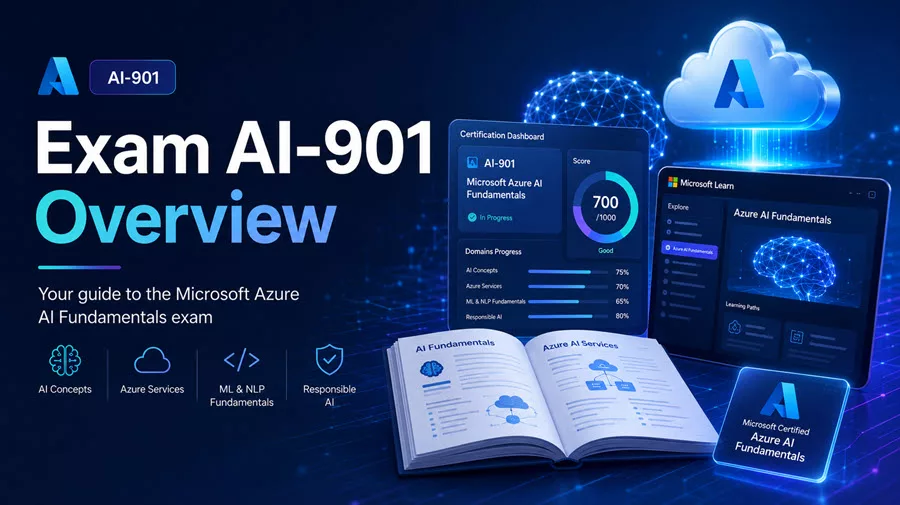
The passing score is 700 out of 1000. The exam is available in English and additional languages. If the exam is not available in your preferred language, you can request an additional 30 minutes to complete it.
At the time of writing, the Practice Assessment for this exam is not yet available. Microsoft notes that Practice Assessments are usually available within eight weeks after an exam is out of beta and generally available.
The exam is open book. You have access to Microsoft Learn documentation during the exam, which you can use to double-check answers. However, be careful not to rely on it too much — use it as a safety net for specific details, not as a replacement for preparation.
AI-900 Retirement and AI-901 Replacement
As of March 2026, Microsoft has confirmed that the Microsoft Certified: Azure AI Fundamentals certification based on Exam AI-900, the related exam, and renewal assessments will retire on June 30, 2026. After that date, you will no longer be able to earn or renew this certification.
The AI-900 certification focused on describing AI concepts and Azure AI services at a high level. It assessed skills such as describing AI workloads and considerations, fundamental principles of machine learning, features of computer vision, natural language processing, and generative AI on Azure. It was a descriptive, conceptual exam with no hands-on implementation requirements.
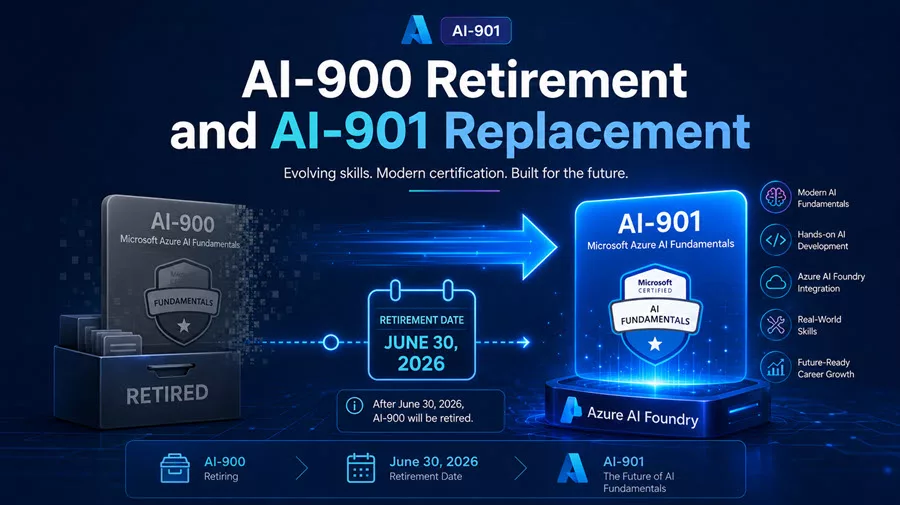
The new AI-901 exam is the successor path as Microsoft retires AI-900. AI-901 expands beyond the descriptive scope of AI-900 by adding hands-on implementation skills using Microsoft Foundry.
AI-901 is not just a renamed AI-900. It is broader and more technical. While AI-900 focused on describing what Azure AI services could do, AI-901 expands the scope to include:
- Implementing generative AI applications and agents using Foundry
- Building lightweight client applications using the Foundry SDK
- Using Python to interact with AI services
- Deploying models and configuring deployment parameters
- Extracting information from documents, images, audio, and video using Azure Content Understanding
- Working with multimodal models for vision and speech
- Creating and testing AI agent solutions in the Foundry portal
This makes AI-901 more aligned with today’s practical AI development responsibilities.
Exam AI-901 Target Audience
The AI-901 exam is intended for technology professionals at the beginning of their career in AI solution development. This includes professionals who work with:
- Microsoft Foundry
- Azure AI services
- Generative AI models and agents
- Azure Language services
- Azure Speech services
- Azure Computer Vision
- Azure Content Understanding
- Python applications that interact with Azure AI
- Azure cloud resources
In this role, you work toward building AI-powered applications and solutions that leverage Microsoft Azure’s AI capabilities.
You are a good candidate for this exam if you:
- Are at the beginning of your career in AI solution development.
- Want to validate foundational technical skills for working with Azure AI solutions.
- Have a basic understanding of Python coding syntax and programming techniques.
- Are familiar with core cloud computing concepts.
- Want to build lightweight AI applications using Microsoft Foundry.
- Are making the transition from descriptive AI knowledge (AI-900) to hands-on AI implementation.
Exam AI-901 Prerequisites
There are no formal prerequisites listed for Exam AI-901, but it is not a purely conceptual beginner exam. It combines foundational AI knowledge with hands-on technical implementation.
Before taking this exam, you should have knowledge or experience with:
- Python coding syntax and programming techniques — The exam expects you to be able to build lightweight client applications using Python and the Foundry SDK. You do not need to be an expert Python developer, but you should be comfortable reading and writing basic Python code.
- Core cloud computing concepts — You should understand cloud storage, cloud compute, and cloud-based authentication and authorization.
- Microsoft Azure resources — You should be familiar with how Azure resources are provisioned and managed.
- Foundational AI and machine learning concepts — You should understand basic AI terminology, generative AI principles, and how large language models (LLMs) work.
You do not need prior experience with Microsoft Foundry before taking the exam, but hands-on practice in the Foundry portal is strongly recommended.
If you have no AI background at all, you may also benefit from completing the AI concepts for developers and technology professionals learning path on Microsoft Learn before starting your exam preparation.
Exam AI-901 Preparation
How do you prepare for the AI-901 exam?
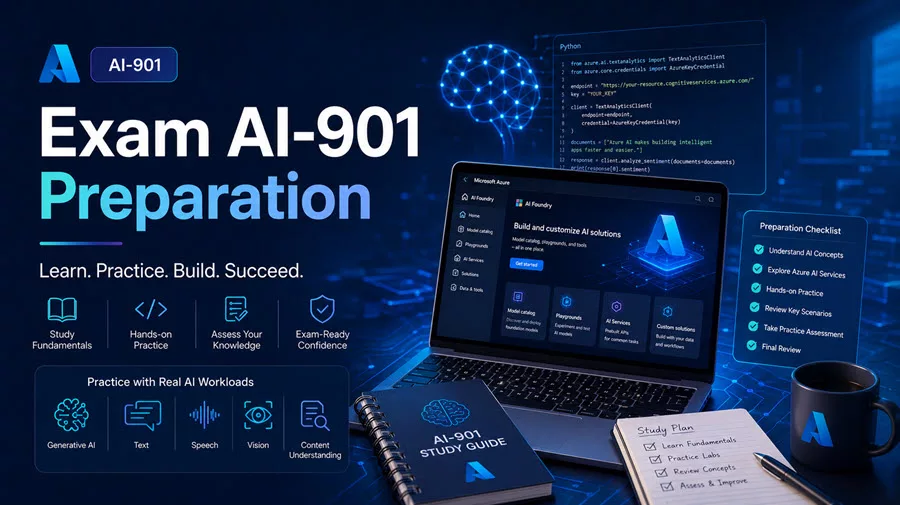
This exam is a mix of conceptual understanding and hands-on implementation. You should not only understand AI concepts but also know how to use the Foundry portal, write basic Python code with the Foundry SDK, and build lightweight AI applications.
You should be comfortable answering questions such as:
- How do generative AI models work?
- What is the difference between a system prompt and a user prompt?
- How do you deploy a model in the Foundry portal?
- How do you create a lightweight chat client application using the Foundry SDK?
- How do you create and test a single-agent solution?
- How do you build a text analysis application?
- How do you use Azure Speech to respond to spoken prompts?
- How do you analyze images using a multimodal model?
- How do you generate new images using generative models?
- How do you extract information from a document or form using Azure Content Understanding?
- How do you extract information from images, audio, and video using Content Understanding?
- What are the six principles of responsible AI?
- How do you choose the right model for a given scenario?
- What model deployment options and configuration parameters are available?
The exam objectives are detailed, so your preparation should be structured around the official skills measured.
Microsoft also notes that the bullets under each skill area in the official study guide illustrate how the skill is assessed, and related topics may also be covered on the exam.
Skills Measured on The AI-901 Exam
The AI-901 exam measures two main skill areas.
| Skill Area | Weight |
|---|---|
| Identify AI concepts and capabilities | 40–45% |
| Implement AI solutions by using Microsoft Foundry | 55–60% |
As you can see, the largest section is Implement AI solutions by using Microsoft Foundry, which represents 55–60% of the exam. This means you need to spend the majority of your preparation time on practical implementation using Microsoft Foundry, not just theory.
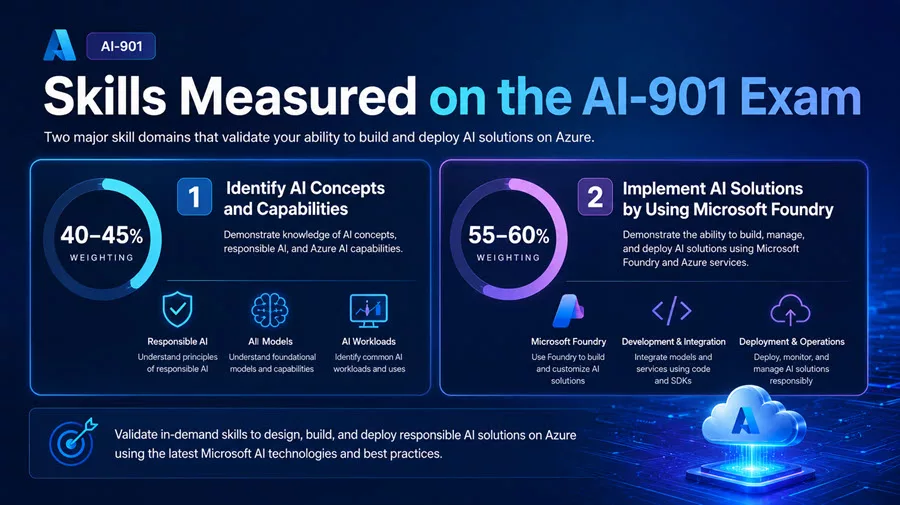
Identify AI Concepts and Capabilities — 40–45%
This section focuses on foundational AI concepts, responsible AI principles, how AI models work, and what AI workloads look like in practice.
Describe Principles of Responsible AI
You should know how to describe considerations for each of the six responsible AI principles:
- Fairness — AI systems should treat all people fairly and avoid bias.
- Reliability and safety — AI systems should perform reliably and safely, especially in critical scenarios.
- Privacy and security — AI systems should protect personal data and operate securely.
- Inclusiveness — AI systems should benefit everyone and should not exclude people.
- Transparency — AI systems should be understandable and explainable.
- Accountability — There should be clear human accountability for AI systems and their outcomes.
These six principles are not new to AI-901. They appeared in AI-900 as well. You should be able to describe each principle clearly and apply them to real-world AI scenarios.
Identify AI Model Components and Configurations
You should know how to:
- Describe how generative AI models work, including the role of large language models (LLMs), tokens, embeddings, and the process of generating responses.
- Identify an appropriate AI model based on capabilities — for example, knowing when to use a language model, a multimodal model, a vision model, or a speech model.
- Identify appropriate model deployment options and configuration parameters, including temperature, max tokens, and system prompts.
You should understand how LLMs process input and generate output, and how configuration parameters affect model behavior. For example, higher temperature values increase response creativity, while lower values produce more deterministic outputs.
Identify AI Workloads
You should know how to:
- Identify scenarios for common AI workloads, including:
- Generative AI
- Agentic AI
- Text analysis
- Speech
- Computer vision
- Information extraction
- Describe common text analysis techniques, including keyword extraction, entity detection, sentiment analysis, and summarization
- Identify features and capabilities of speech recognition and speech synthesis
- Identify features and capabilities of computer vision and image-generation models
- Identify techniques to extract information from text, images, audio, and videos
This section validates your ability to recognize which AI workload is appropriate for a given scenario and understand what each workload is capable of. For example, you should know the difference between sentiment analysis and entity recognition, when to use speech-to-text versus text-to-speech, and how image classification differs from object detection.
Implement AI Solutions by Using Microsoft Foundry — 55–60%
This is the largest and most important section of the AI-901 exam. It covers four implementation areas, all centered around Microsoft Foundry.
Implement Generative AI Apps and Agents by Using Foundry
This is one of the most important new areas compared with AI-900.
You should know how to:
- Create effective system and user prompts for generative AI models
- Deploy a model and interact with it in the Foundry portal
- Create a lightweight chat client application by using the Foundry SDK
- Create and test a single-agent solution in the Foundry portal
- Create a lightweight client application for an agent
Generative AI and agentic AI are the centerpiece of AI-901. You should understand how prompt engineering works, how to structure system messages and user messages, and how agent solutions differ from simple chat applications.
You should also be comfortable navigating the Microsoft Foundry portal, deploying a model from the model catalog, and using the Foundry SDK in Python to build a basic chat client.
For agents, you should understand how to create a single-agent solution that uses a model and optionally includes tools or functions. You should also understand how to test and interact with an agent in the Foundry portal.
Implement AI Solutions for Text and Speech by Using Foundry
You should know how to:
- Build a lightweight application that includes text analysis
- Respond to spoken prompts by using a deployed multimodal model
- Build a lightweight application by using Azure Speech in Foundry Tools
Text and speech capabilities are closely related to natural language processing workloads from AI-900, but AI-901 goes further by expecting you to actually build lightweight applications. You should understand how to use Azure Language in Foundry Tools for text analysis, and how to use Azure Speech in Foundry Tools for recognizing and synthesizing speech.
You should also know how a multimodal model can process spoken input and respond accordingly, which blends speech capabilities with generative AI.
Implement AI Solutions with Computer Vision and Image-Generation Capabilities by Using Foundry
You should know how to:
- Interpret visual input in prompts by using a deployed multimodal model
- Create new visual outputs by using generative models
- Build a lightweight application that includes vision capabilities
Computer vision in AI-901 goes beyond just analyzing existing images. You should understand how multimodal models can receive image input and generate responses, and how image-generation models can create new visual content from text prompts.
You should be comfortable building a lightweight Python application that submits images to a deployed model and processes the response.
Implement AI Solutions for Information Extraction by Using Foundry
You should know how to:
- Extract information from documents and forms by using Azure Content Understanding in Foundry Tools
- Extract information from images by using Content Understanding
- Extract information from audio and video by using Content Understanding
- Build a lightweight application with information extraction capabilities by using Content Understanding
Information extraction is a key AI workload for document intelligence, form processing, and unstructured content analysis. Azure Content Understanding in Foundry Tools allows you to extract structured data from a wide variety of content types, including documents, images, audio files, and videos.
You should understand when to use Content Understanding versus other approaches, and how to build a lightweight Python application that calls the Content Understanding API to extract information.
Exam AI-901 Learning Path and Study Resources
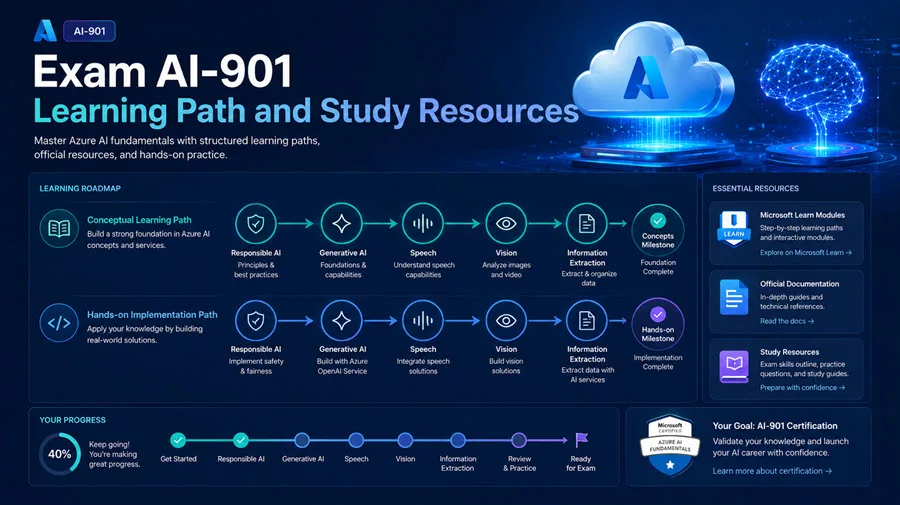
I highly recommend gaining hands-on experience before taking the exam. Two official learning paths on Microsoft Learn are directly aligned with the AI-901 exam. You should use both, along with the official Microsoft study guide, as your primary references.
To prepare effectively, I curated the following list of official Microsoft documentation and learning resources, organized by exam domain.
Identify AI Concepts and Capabilities
Responsible AI
- Responsible AI principles from Microsoft
- Responsible AI overview
- Transparency in AI systems
- Fairness in machine learning
AI Models and Configurations
- What is a large language model (LLM)?
- Microsoft Foundry model catalog
- Deploy models in Azure AI Foundry portal
- Prompt engineering overview
- System message framework and template recommendations
- Azure OpenAI model configurations (temperature, max tokens)
AI Workloads
- What is Azure AI Language?
- Text analytics overview
- Key phrase extraction
- Named entity recognition (NER)
- Sentiment analysis
- Text summarization
- What is Azure AI Speech?
- Speech-to-text overview
- Text-to-speech overview
- What is Azure AI Vision?
- Image analysis overview
- What is Azure AI Content Understanding?
Implement AI Solutions by Using Microsoft Foundry
Generative AI Apps and Agents
- What is Microsoft Foundry?
- Azure AI Foundry overview
- Get started with Azure AI Foundry SDK
- Build a basic chat app with the Azure AI Foundry SDK
- What are AI agents?
- Azure AI Foundry Agent Service overview
- Create and manage agents in Azure AI Foundry portal
- Prompt engineering techniques
Text and Speech
- Quickstart: Azure AI Language in Foundry Tools
- Build a text analysis application in Python
- Quickstart: Azure AI Speech in Foundry Tools
- Speech recognition in Python
- Speech synthesis in Python
- Use multimodal models for speech input
Computer Vision and Image Generation
- Use vision-enabled models in Foundry
- Azure OpenAI GPT-4o and image analysis
- Image generation with DALL-E
- Image generation quickstart in Python
- Build a vision application in Python
Information Extraction
- Azure AI Content Understanding overview
- Quickstart: Azure AI Content Understanding
- Extract information from documents using Content Understanding
- Extract information from images using Content Understanding
- Extract information from audio and video using Content Understanding
- Build a Content Understanding application in Python
Official Learning Paths
Microsoft Learn provides two official learning paths that are directly mapped to the AI-901 exam. Both are free and available at beginner level.
Learning Path 1: AI concepts for developers and technology professionals
This learning path covers the conceptual foundation of the exam with 6 modules:
- Introduction to AI concepts
- Introduction to generative AI and agents
- Introduction to natural language processing concepts
- Introduction to AI speech concepts
- Introduction to computer vision concepts
- Introduction to AI-powered information extraction concepts
Learning Path 2: Get started with AI applications and agents on Azure
This learning path covers the hands-on implementation portion of the exam with 6 modules:
- Get started with AI in Azure
- Get started with generative AI and agents in Azure
- Get started with text analysis in Azure
- Get started with speech in Azure
- Get started with computer vision in Azure
- Get started with AI-powered information extraction in Azure
Because AI-901 is a hands-on implementation exam, reading alone is not enough. You should get hands-on experience in the Microsoft Foundry portal, build lightweight Python applications using the Foundry SDK, and practice with Azure AI services for text, speech, vision, and content understanding.
AI-901 Example Exam Scenarios
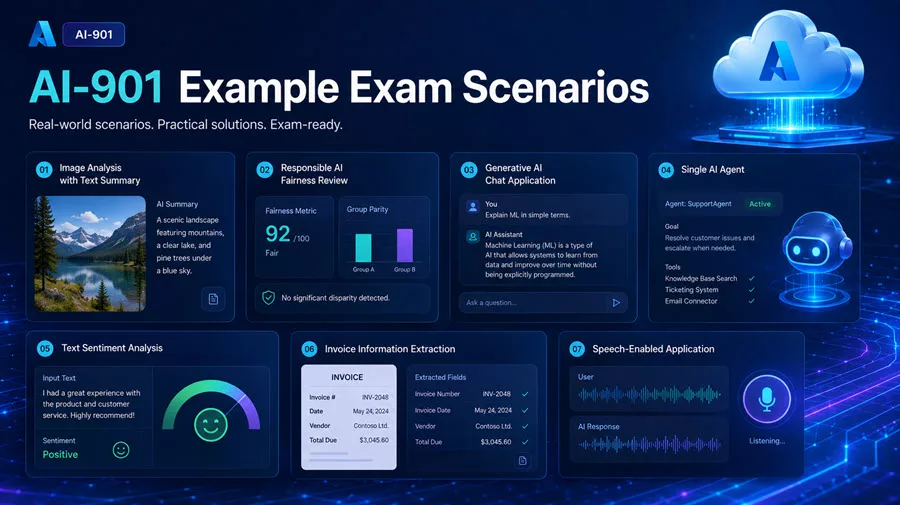
Scenario 1: Choosing the Right AI Model
Your organization needs an AI solution that can analyze an image and generate a descriptive text summary of its contents.
Best approach:
- Identify this as a computer vision workload that also requires language generation.
- Select a multimodal model that accepts both text and image input.
- Deploy the model in the Foundry portal.
- Submit the image as part of the prompt and process the text response.
Scenario 2: Responsible AI Concern
A development team builds an AI hiring tool. Initial testing shows that the model consistently scores one demographic group lower than others for the same qualifications.
Best approach:
- Identify this as a fairness concern under the responsible AI principles.
- The team should review the training data for bias.
- Apply fairness assessment tools such as Azure Machine Learning’s fairness dashboard.
- Retest the model after addressing the identified bias.
Scenario 3: Building a Generative AI Chat Application
You need to build a lightweight Python application that connects to a deployed generative AI model and maintains a conversation.
Best approach:
- Use the Foundry SDK to create a chat client.
- Configure a system prompt to define the assistant’s behavior.
- Use the chat completions API to send user messages and receive responses.
- Handle the conversation history to maintain context across turns.
Scenario 4: Creating an AI Agent
Your team wants to build an agent that can answer customer questions and perform basic tasks, such as checking order status.
Best approach:
- Create a single-agent solution in the Microsoft Foundry portal.
- Configure the agent with a system prompt defining its role and behavior.
- Add tools or functions the agent can call to retrieve order information.
- Test the agent in the Foundry portal playground.
- Build a lightweight Python client application that connects to the agent.
Scenario 5: Text Analysis Application
Your organization processes customer feedback in bulk and needs to automatically identify sentiment and extract key topics from each response.
Best approach:
- Identify this as a text analysis workload.
- Use Azure Language in Foundry Tools for sentiment analysis and key phrase extraction.
- Build a lightweight Python application that sends text to the Language service and processes the response.
- Consider summarization if the feedback is very long.
Scenario 6: Information Extraction from Documents
Your organization receives supplier invoices in PDF format and needs to extract key fields such as invoice number, date, line items, and totals automatically.
Best approach:
- Identify this as an information extraction workload.
- Use Azure Content Understanding in Foundry Tools to extract structured data from document files.
- Build a lightweight Python application that submits documents to the Content Understanding API.
- Process the extracted fields and store them in a structured format.
Scenario 7: Speech-Enabled Application
You need to build an application that listens to a user’s spoken question, sends it to a generative AI model, and reads the response aloud.
Best approach:
- Use Azure Speech in Foundry Tools for speech recognition (speech-to-text).
- Send the recognized text as a prompt to a deployed generative AI model using the Foundry SDK.
- Receive the model’s text response.
- Use Azure Speech for speech synthesis (text-to-speech) to read the response aloud.
Schedule Exam AI-901
Once you are ready, you can schedule Exam AI-901 from the official Microsoft Learn certification page: Schedule Exam AI-901.
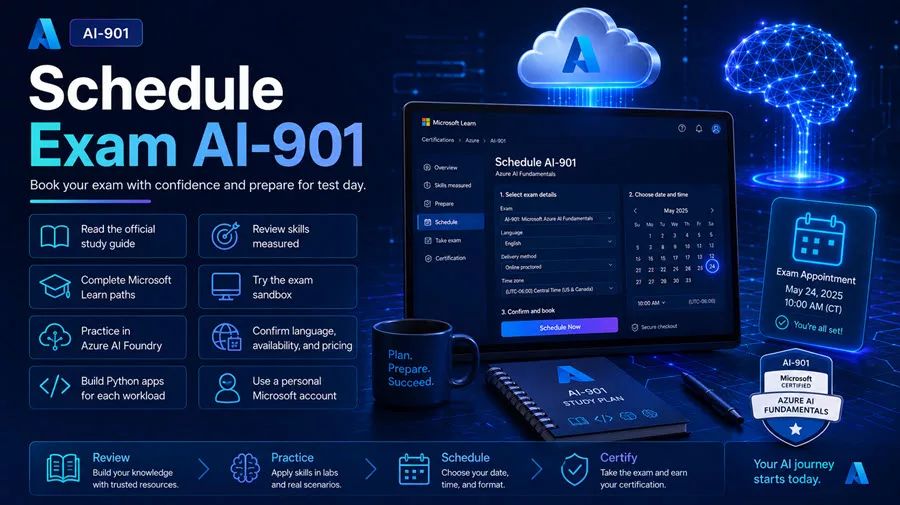
Please note that exam details, availability, and pricing can change. Always confirm the latest information on the official Microsoft Learn exam page before registering. Before scheduling, make sure you:
- Read the official Microsoft study guide carefully; we already discussed it here.
- Complete both recommended learning paths on Microsoft Learn.
- Get hands-on practice in the Microsoft Foundry portal.
- Build at least one lightweight Python application for each AI workload covered.
- Review all skills measured in both domains.
- If you are taking a Microsoft exam for the first time, use the exam sandbox to familiarize yourself with the exam experience.
- Confirm the latest exam availability, language, and pricing in your region.
I strongly recommend using a personal Microsoft account when registering for Microsoft certification exams. If you register with an organizational account, your exam records could be impacted if you leave the organization.
AI-901 Exam Tips
Here are my recommendations to prepare for and pass the AI-901 exam:
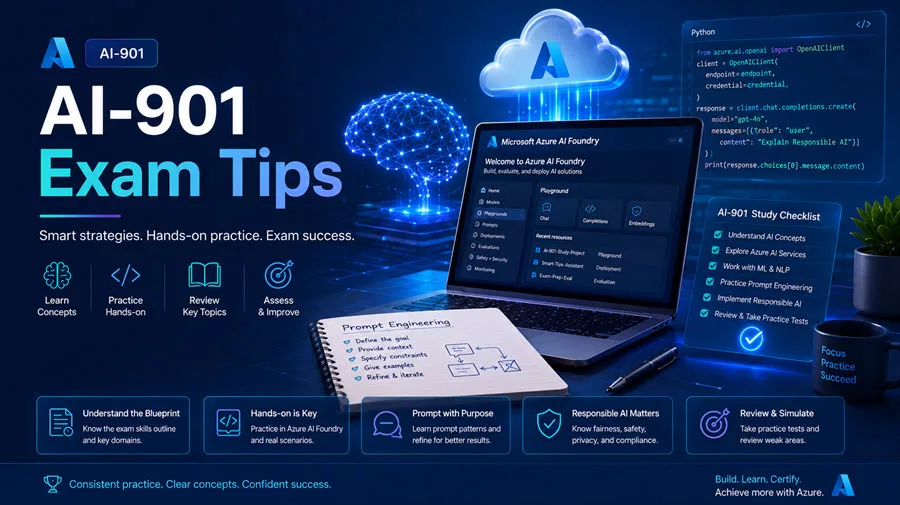
- Do not prepare using only the AI-900 blueprint. AI-901 is more technical and requires hands-on implementation skills.
- Pay special attention to Microsoft Foundry — it is the central platform for the entire implementation section of the exam.
- Get hands-on experience in the Foundry portal. Deploy a model, interact with it, and build a basic chat application.
- Write Python code. Even at a beginner level, you should be able to read and understand Foundry SDK code and write basic client applications.
- Understand the six responsible AI principles deeply — fairness, reliability and safety, privacy and security, inclusiveness, transparency, and accountability. Know how to describe and apply each one.
- Know the difference between AI workloads: generative AI, agentic AI, text analysis, speech, computer vision, and information extraction.
- Understand how to choose the right model for a given scenario and how configuration parameters such as temperature affect model behavior.
- Practice prompt engineering — system prompts, user prompts, and how to structure effective prompts.
- Build a basic agent solution in the Foundry portal and understand how agents differ from simple chat applications.
- Review Azure Content Understanding and understand what content types it can process (documents, images, audio, video).
- Use the official learning paths on Microsoft Learn — both are directly aligned to the exam and include hands-on exercises.
The best exam mindset is: Think like an AI developer at the beginning of your career — understand the concepts, choose the right tools, and know how to implement a working solution using Microsoft Foundry.
Other Microsoft Certification Exams
Are you interested in another Microsoft certification exam? We highly recommend checking out the following certification paths:
- Exam SC-900: Microsoft Security, Compliance, and Identity Fundamentals
- Exam SC-200: Microsoft Security Operations Analyst
- Exam SC-300: Microsoft Identity and Access Administrator
- Exam SC-401: Administering Information Security in Microsoft 365
- Exam SC-500: Cloud and AI Security Engineer Associate
- Exam SC-100: Microsoft Cybersecurity Architect
- Exam SC-730: Cybersecurity Business Professional
- Exam MS-102: Microsoft 365 Administrator
- Exam AZ-104: Microsoft Azure Administrator
- Exam AZ-305: Microsoft Azure Solutions Architect Expert
Conclusion
The new Microsoft Certified: Azure AI Fundamentals certification based on Exam AI-901 is a significant update to Microsoft’s AI certification portfolio. With AI-900 retiring on June 30, 2026, technology professionals who want to validate their foundational AI skills on Azure should shift their focus to AI-901, which reflects the modern requirements of working with AI solutions using Microsoft Foundry.
The AI-901 exam validates that you understand AI concepts and responsible AI principles, can identify the right AI workload and model for a given scenario, and have the hands-on technical skills to implement lightweight AI solutions using Microsoft Foundry, Python, and Azure AI services.
If you already have AI-900 experience, this certification is the natural next step. The conceptual foundation carries over, but you will need to invest additional time getting hands-on with Microsoft Foundry, the Foundry SDK, Azure Content Understanding, and Python-based AI application development.
If you are new to AI on Azure, start with the two official Microsoft Learn learning paths — AI concepts for developers and technology professionals and Get started with AI applications and agents on Azure — before attempting the exam. Both paths are beginner-level, free, and directly aligned to the exam objectives.
Good luck with your AI-901 exam preparation, and let us know once you pass in the comments section below!
Remember, you can always support us in developing tools and creating content via Why Contribute? – Charbelnemnom.com Cloud & Cybersecurity
__
Thank you for reading our blog.
Please let us know in the comments section below if you have any questions or feedback.
-Charbel Nemnom-
