
Updated – 02/09/2026 – Microsoft has published hands-on training labs for the SC-500 exam. For more details, check the Exam SC-500 Training Labs section below.
Updated – 28/07/2026 – Exam SC-500 is now generally available (out of beta). Microsoft has also launched the Microsoft Defender Skilling Challenge (July 20–August 21, 2026): complete the challenge for a chance to win a voucher for 50% off the SC-500 (or SC-200) exam. For more details, check the Schedule Exam SC-500 section below.
Updated – 27/07/2026 – Microsoft has published a dedicated course, SC-500T00: Implement end-to-end security controls for cloud and AI workloads. It is organized into 12 dedicated learning paths comprising 63 modules in total, aligned to the four skills measured on the exam. For more details, check the Exam SC-500 Learning Path and Study Resources section below.
Updated – 10/06/2026 – I took the SC-500 exam and documented my experience and takeaways in this section in case it helps others preparing for it. Good luck!
Microsoft has announced the new Microsoft Certified: Cloud and AI Security Engineer Associate certification, which is earned by passing Exam SC-500: Implementing End-to-End Security Controls for Cloud and AI Workloads. This new certification is especially important for security engineers who protect cloud, hybrid, multicloud, and AI workloads using Microsoft security technologies.
As a side note, Microsoft has also announced that the Microsoft Certified: Azure Security Engineer Associate certification, the related AZ-500 exam, and renewal assessments will retire on August 31, 2026. After this date, you will no longer be able to earn or renew the AZ-500 certification.
The new SC-500 exam is the natural evolution for security engineers who need to secure modern cloud and AI workloads across identity, networking, storage, databases, compute, AI solutions, security posture management, and monitoring.
In this study guide, I will share everything you need to know to prepare for and pass Exam SC-500: Implementing End-to-End Security Controls for Cloud and AI Workloads.
Table of Contents
Introduction
Security engineering is changing quickly. In the past, securing Azure infrastructure was primarily focused on identity, access, networking, compute, storage, data, and Microsoft Defender for Cloud. These areas are still important, but the security landscape has expanded significantly.
Today, security engineers must also secure AI workloads, agents, cloud-native applications, containers, hybrid servers, multicloud environments, data exposure risks, and security posture across multiple platforms. And this is where Exam SC-500 comes in.
The new Exam SC-500 focuses on implementing end-to-end security controls for cloud and AI workloads. This exam expands beyond traditional Azure security by including modern security responsibilities across Microsoft Entra ID, Azure Key Vault, Azure Policy, Microsoft Defender for Cloud, Microsoft Sentinel, Microsoft Security Copilot, Microsoft Purview Data Security Posture Management, AI agents, Azure networking, storage, databases, compute, containers, hybrid servers, and multicloud environments.
If you are currently preparing for AZ-500, or if you already hold the Azure Security Engineer Associate certification, SC-500 is the new certification path you should start reviewing.
Exam SC-500 Overview
The official exam title is: SC-500: Implementing End-to-End Security Controls for Cloud and AI Workloads.
This exam is designed for security engineers who protect organizational systems and data across cloud and hybrid environments by implementing comprehensive security controls that help prevent unauthorized access and reduce risk.
This role spans multiple security domains, including identity, network, application, data, compute, and AI workloads. Security engineers also help ensure platforms, data, identities, and infrastructure used by AI workloads are securely implemented and monitored.
For this exam, you should have practical experience administering Azure and hybrid environments, including compute, network, and storage. You also need strong familiarity with Microsoft Entra ID and familiarity with Microsoft 365 administration.
The passing score is 700 out of 1000. The exam duration is 120 minutes. Exam SC-500 is now generally available after completing its beta period and is available in the following 10 languages.
- Chinese Simplified
- Chinese Traditional
- English
- French
- German
- Italian
- Japanese
- Korean
- Portuguese-Brazilian
- Spanish-Modern
At the time of writing, the Practice Assessment for this exam is not yet available; Microsoft notes that Practice Assessments are usually published within eight weeks after an exam becomes generally available, so it should appear soon.
Now that the exam is generally available, it is scored immediately, and you receive your pass or fail result as soon as you finish it.
Microsoft CISO advice: Securing AI with full-stack red teaming, and that’s why the SC-500 exam is full-stack.
AZ-500 Retirement and SC-500 Replacement
Microsoft has confirmed that the Microsoft Certified: Azure Security Engineer Associate certification, the related exam, and renewal assessments will retire on August 31, 2026. After that date, you will no longer be able to earn or renew this certification.
The AZ-500 certification focused on implementing, managing, and monitoring security for Azure resources, multicloud, and hybrid environments. It assessed skills such as securing identity and access, networking, compute, storage, databases, and Azure security using Microsoft Defender for Cloud and Microsoft Sentinel.
The new SC-500 exam is the successor path for Azure security engineers as Microsoft retires AZ-500. SC-500 expands the traditional Azure security scope by adding modern cloud, hybrid, multicloud, and AI workload security responsibilities.
SC-500 is not just a renamed AZ-500. It is broader. While AZ-500 focused heavily on Azure security engineering, SC-500 expands the scope to include:
- AI workload security
- Microsoft Copilot and AI app risks
- Microsoft Entra Agent ID
- Microsoft Purview Data Security Posture Management
- Defender for Cloud Security Posture Management
- Microsoft Security Copilot
- Hybrid and multicloud posture management
- End-to-end security controls for modern workloads
This makes SC-500 more aligned with today’s cloud and AI security responsibilities.
Exam SC-500 Target Audience
The SC-500 exam is intended for security engineers who are responsible for securing cloud, hybrid, and AI workloads. This includes professionals who work with:
- Microsoft Entra ID
- Azure Key Vault
- Azure Policy
- Microsoft Defender for Cloud
- Defender for Cloud Security Posture Management
- Microsoft Defender for Servers
- Microsoft Defender for Storage
- Microsoft Defender for Databases
- Microsoft Defender for Containers
- Microsoft Sentinel
- Microsoft Security Copilot
- Azure networking
- Azure Storage
- Azure SQL
- Azure virtual machines
- Azure Arc
- Azure Kubernetes Service
- Azure App Service
- Azure Functions
- Azure Logic Apps
- Azure API Management
- Microsoft Purview
- Microsoft Copilot and AI apps
- Microsoft Foundry and AI workloads
In this role, you work closely with architects, administrators, engineers, analysts, and developers responsible for Azure, Microsoft 365, identity and access, information protection, security operations, DevOps, application development, database platforms, and networks.
You are a good candidate for this exam if you:
- Implement security controls across Azure and hybrid environments.
- Manage identity and access security.
- Secure storage, databases, and networking.
- Secure compute and application platforms.
- Implement controls for AI workloads and agents.
- Manage and monitor security posture.
- Use Microsoft Defender for Cloud and Microsoft Sentinel.
- Work with security recommendations, regulatory compliance, and vulnerability management.
Exam SC-500 Prerequisites
There are no formal prerequisites listed for Exam SC-500, but it is not a beginner exam; it’s intermediate to advanced.
Before taking this exam, you should have practical experience with:
- Microsoft Azure administration
- Hybrid cloud environments
- Azure compute
- Azure networking
- Azure storage
- Microsoft Entra ID
- Microsoft 365 administration
- Security operations concepts
- Microsoft Defender for Cloud
- Microsoft Sentinel
- Azure Policy
- Role-based access control
- Workload protection
- Cloud security posture management
You should also understand modern AI security risks, especially around data exposure, Copilot, AI apps, agents, and AI workload protection.
Exam SC-500 Preparation
How do you prepare for the SC-500 exam?
This exam is implementation-focused. You should not only understand concepts but also know how to configure and apply security controls across Azure and Microsoft security services.
You should be comfortable answering questions such as:
- How do you configure Conditional Access?
- How do you secure privileged access with PIM?
- How do you secure secrets and keys in Azure Key Vault?
- How do you enforce security compliance with Azure Policy?
- How do you configure backup protection security controls?
- How do you use infrastructure as code to configure security controls?
- How do you configure Defender for Cloud recommendations and workload protection?
- How do you secure storage accounts and databases?
- How do you configure private endpoints and Private Link?
- How do you secure Azure Firewall and network access?
- How do you secure Microsoft Entra Private Access?
- How do you secure virtual machines and hybrid servers?
- How do you protect containers, AKS, App Service, Functions, Logic Apps, and APIs?
- How do you monitor posture with Defender CSPM?
- How do you collect security events in Microsoft Sentinel?
- How do you configure Microsoft Security Copilot?
- How do you identify and manage security risks related to AI workloads?
The exam objectives are detailed, so your preparation should be structured around the official skills measured.
Microsoft also notes that the bullets under each skill area illustrate how the skill is assessed, and related topics may also be covered on the exam.
Skills Measured on The SC-500 Exam
The SC-500 exam measures four main skill areas.
| Skills measured | Weight |
|---|---|
| Manage identity, access, and governance | 20–25% |
| Secure storage, databases, and networking | 25–30% |
| Secure compute | 20–25% |
| Manage and monitor security posture | 20–25% |
As you can see, the highest-weighted section is Secure storage, databases, and networking, which represents 25–30% of the exam. However, all four sections are weighted closely, so you need balanced preparation across the entire exam blueprint.
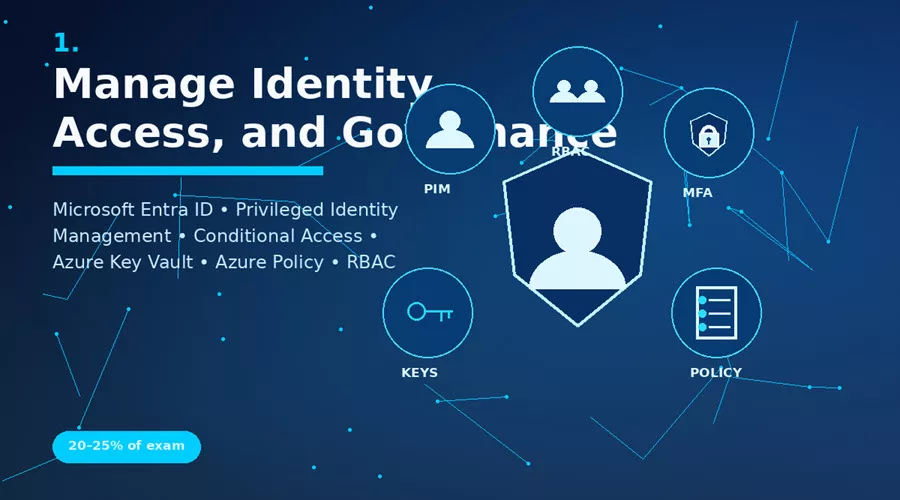
Manage Identity, Access, and Governance — 20–25%
This section focuses on securing access to resources, protecting secrets and keys, and enforcing governance and regulatory compliance.
Secure Access to Resources by Using Microsoft Entra ID
You should know how to implement and configure:
- Privileged Identity Management
- Conditional Access policies
- Authentication methods, including multifactor authentication and passwordless authentication
- Identity for applications, including enterprise applications and app registrations
- OAuth permission grants and consent settings
- Managed identities for Azure resources
You should understand when to use Conditional Access, how to reduce standing privileges with Privileged Identity Management, and how to secure application access.
You should also understand how managed identities help Azure resources authenticate securely without storing credentials in code.
Secure Secrets and Keys by Using Azure Key Vault
You should know how to:
- Deploy Azure Key Vault
- Configure Key Vault settings
- Configure access to Key Vault
- Configure firewall settings on Key Vault
- Manage keys, secrets, and certificates
- Scan for secrets using Defender for Cloud Security Posture Management
- Implement Defender for Key Vault
Azure Key Vault is a key service for protecting secrets, certificates, and cryptographic keys used by applications and workloads.
You should understand how to limit access to secrets and keys, protect Key Vault from public exposure, and monitor threats against Key Vault resources.
Implement Governance to Enforce Security and Regulatory Compliance
You should know how to:
- Implement and configure security controls by using Azure Policy, including built-in and custom policy definitions
- Evaluate regulatory compliance by using Microsoft Defender for Cloud
- Implement and configure security controls in Defender for Cloud, including security standards and recommendations
- Implement resource locks
- Manage Azure built-in role assignments
- Manage custom roles, including Azure roles and Microsoft Entra roles
- Evaluate and remediate overprivileged access assignments by using Azure RBAC
- Configure security controls for backup protection by using Azure Backup security features
- Implement and configure security controls by using infrastructure as code
This section is important because cloud security is not only about protecting individual resources. It is also about applying consistent policies and enforcing governance at scale.
You should also understand how infrastructure as code can be used to configure and enforce security controls consistently across Azure environments.
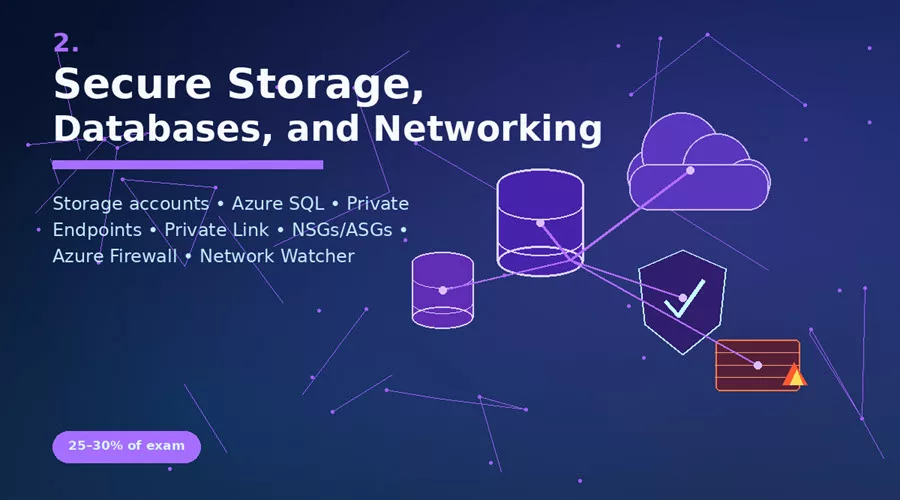
Secure Storage, Databases, and Networking — 25–30%
This is the largest SC-500 exam section. It covers storage account security, database protection, and Azure network security services.
Implement Security for Storage Accounts
You should know how to:
- Implement and configure security for storage accounts
- Configure Azure Storage firewall rules
- Implement Defender for Storage threat protection configurations
- Manage access to storage, including access policies
Focus on secure access, network restrictions, threat protection, and proper permissions.
Storage accounts often contain business-critical data, so you should understand how to reduce exposure, limit access, and monitor for suspicious activity.
Implement Security for Databases
You should know how to:
- Implement platform-level security configurations in Azure SQL
- Configure database auditing for Azure SQL Database and Azure SQL Managed Instance
- Configure Defender for Databases protection across Azure database services
You should understand how database auditing and Defender for Databases help detect, monitor, and protect database workloads. You should also understand why database protection is important for compliance, investigation, and threat detection.
Implement Security for Azure Network Services
You should know how to implement and configure:
- Network security groups
- Application security groups
- Network access policies using Azure Virtual Network Manager
- Security for Azure Virtual WAN
- Security for virtual private network connections
- Microsoft Entra Private Access
- Azure private endpoints for Azure platform as a service resources
- Azure Private Link services for network resources
- Azure Firewall
- Azure Network Watcher diagnostics
Networking is a critical part of this exam. You should understand how to reduce public exposure, secure access to PaaS services, inspect traffic, and evaluate effective security rules.
You should also understand when to use Private Endpoints, Private Link, Azure Firewall, and Network Watcher diagnostics to secure and troubleshoot network access.
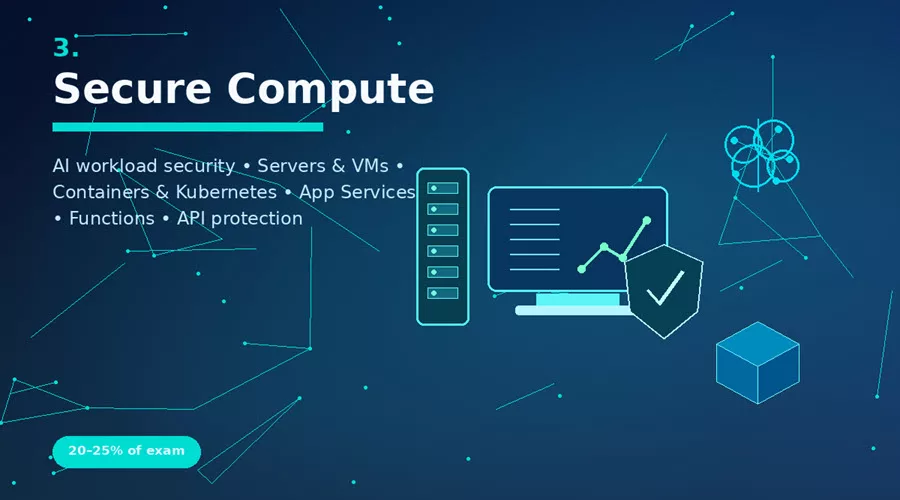
Secure Compute — 20–25%
This section includes AI security, virtual machine security, server protection, and application platform security.
Implement Security for AI
This is one of the most important new areas compared with AZ-500.
You should know how to:
- Identify overexposure of data in SharePoint
- Identify risks related to Microsoft Copilot and AI apps by using Microsoft Purview Data Security Posture Management (DSPM)
- Enable and configure real-time protection for Microsoft Copilot Studio agents
- Implement Conditional Access for Microsoft Entra Agent ID
- Analyze blast radius for security risks related to Entra Agent ID by using Defender XDR
- Manage Entra Agent ID access
- Configure and deploy AI Gateway in Azure API Management for Microsoft Foundry
- Enable Defender for AI Service in Cloud Workload Protection in Defender for Cloud
- Configure guardrails for agent security in Foundry
- Monitor AI security by using the Data and AI security dashboard in Defender for Cloud
- Manage agents in the Microsoft 365 admin center
This is a major reason why the new exam is called Cloud and AI Security Engineer Associate.
Security engineers now need to understand how AI workloads, AI apps, Microsoft Copilot experiences, Copilot Studio agents, Microsoft Entra Agent ID, and Foundry workloads affect enterprise security.
You should also understand that AI security is closely connected to data security. If sensitive information is overexposed in SharePoint or other services, AI tools may surface information to users who should not have access.
Implement Security for Servers and Virtual Machines
You should know how to:
- Implement and configure disk encryption
- Plan and implement Azure Bastion
- Enable and enforce just-in-time VM access
- Extend security controls to hybrid and multicloud servers by using Azure Arc
- Onboard servers to Defender for Servers in Defender for Cloud, including hybrid and multicloud scenarios
- Configure Defender for Servers settings, including vulnerability scanning and endpoint detection and response (EDR)
- Implement and manage agentless scanning for VMs in Defender for Servers
- Configure security features on a VM, including secure boot, virtual Trusted Platform Module, integrity monitoring, and security type
- Enforce security configuration of Azure-managed servers by using Azure Machine Configuration
This section combines classic Azure infrastructure security with hybrid and multicloud server protection. You should know when to use Azure Bastion, just-in-time VM access, disk encryption, secure boot, vTPM, Defender for Servers, and Azure Arc.
Implement Security for Application Platform Services
You should know how to:
- Detect misconfigurations and runtime risks in container workloads by using Defender for Containers
- Implement and configure security controls for Azure Kubernetes Service (AKS)
- Implement and configure security controls for Azure Container Registry
- Implement and configure security controls for Azure Container Instances and Azure Container Apps
- Implement and configure security controls for Azure Functions, including authentication and network access
- Implement and configure security controls for Azure Logic Apps
- Implement and configure security controls for Azure App Service
- Implement and configure Azure Web Application Firewall
- Implement security policies for backend API protection by using Azure API Management
You should also understand how Defender for Containers detects misconfigurations and runtime risks in container workloads. For application services, you should focus on authentication, network access, secure configuration, WAF protection, and API protection.
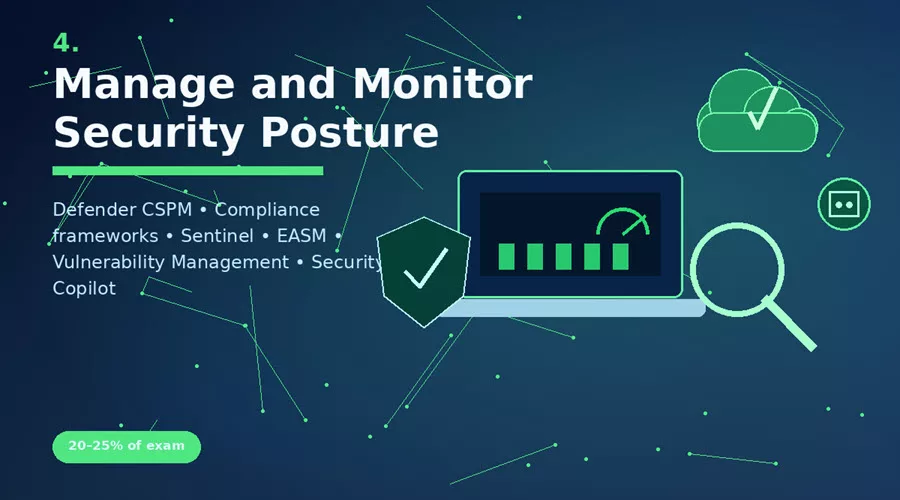
Manage and Monitor Security Posture — 20–25%
This section focuses on Defender for Cloud, Microsoft Sentinel, vulnerability management, external attack surface management, and Microsoft Security Copilot.
Manage Security Posture by Using Microsoft Defender for Cloud
You should know how to:
- Identify security risks using Defender for Cloud Security Posture Management
- Evaluate compliance against security frameworks by using Defender for Cloud
- Enable and configure Defender for Cloud workload protection plans
- Connect hybrid cloud and multicloud environments to Defender for Cloud
- Connect Amazon Web Services environments to Defender for Cloud
- Connect Google Cloud Platform environments to Defender for Cloud
- Configure Microsoft Defender Vulnerability Management settings for Azure VMs
- Discover unprotected assets and vulnerabilities by using Microsoft Defender External Attack Surface Management
This section validates your ability to manage security posture across cloud, hybrid, and multicloud environments. You should understand how Defender for Cloud helps identify risks, prioritize recommendations, assess regulatory compliance, and protect workloads.
Implement Activity and Event Collection in Microsoft Sentinel
You should know how to:
- Create and connect workspaces in Microsoft Sentinel
- Assign roles in Microsoft Sentinel
- Implement and use Content Hub solutions
- Configure and use Microsoft data connectors for Azure resources
- Implement and configure syslog and Common Event Format event collections
- Implement and configure collection of Windows Security events by using data collection rules, including Windows Event Forwarding (WEF)
- Create custom log tables in the workspace to store ingested data
- Implement automation rules and playbooks in Microsoft Sentinel
- Implement data retention in Microsoft Sentinel data stores
- Query Microsoft Purview Audit in Defender XDR
This part of the exam focuses on collecting and managing security signals so teams can monitor, detect, investigate, and respond. You should understand how Microsoft Sentinel connects to Azure resources, Windows Security events, syslog, CEF, and other data sources. You should also understand how automation rules and playbooks help reduce manual response effort.
If you are interested in diving deeper into Microsoft Sentinel, we highly recommend checking out the official Microsoft Press learning course: Exam SC-200: Microsoft Security Operations Analyst.
Implement Microsoft Security Copilot
You should know how to:
- Configure workspaces for Microsoft Security Copilot
- Manage permissions and roles in Microsoft Security Copilot
- Enable and configure plugins
- Enable and configure Microsoft agents and Security Store agents
Security Copilot is now part of the modern Microsoft security engineer skill set, especially as organizations adopt AI-assisted security workflows.
You should understand that Security Copilot is not only a standalone AI assistant. It also connects with Microsoft security services, plugins, agents, and security data to help analysts and engineers investigate, summarize, and act on security information.
Exam SC-500 Learning Path and Study Resources
Microsoft recommends that candidates gain hands-on experience before taking the exam, and there is now a dedicated Microsoft Learn training course for SC-500.
Unlike when this exam first entered beta, Microsoft has published a dedicated course, SC-500T00: Implement end-to-end security controls for cloud and AI workloads, which is now available. The course is rated Intermediate, runs four days (about 96 hours of content) in instructor-led format, and is also offered as self-paced study. It is organized into 12 dedicated learning paths comprising 63 modules in total, aligned to the four skills measured on the exam. All are rated as intermediate (the governance learning path also includes some advanced-level content). These are your primary structured study resource — work through all of them.
If you prefer to prepare for the SC-500 exam with live, Microsoft Certified Trainer (MCT)-led training — a written, instructor-delivered version of this course rather than pre-recorded videos — you can contact me here so we can plan the dates.
Learning Path 1: Secure access to resources by using Microsoft Entra (3 modules)
• Manage and implement authentication methods in Microsoft Entra ID — plan, deploy, and manage authentication methods, MFA with Conditional Access, passwordless options, and self-service password reset
• Implement and configure Privileged Identity Management (PIM) — Just-in-Time privileged access to reduce standing privilege across Microsoft Entra roles, Azure resources, and group-based access
• Authenticate your API plugin for declarative agents with secured APIs — securing API plugins for Microsoft 365 Copilot declarative agents using API key and OAuth2 authentication
Learning Path 2: Secure Azure Key Vault with defense in depth for the cloud and AI workloads (4 modules)
• Configure and secure Azure Key Vault — soft delete and purge protection, least-privilege RBAC with just-in-time activation, and network hardening with firewall rules and private endpoints
• Manage keys and secrets in Azure Key Vault — HSM-backed keys, Bring Your Own Key (BYOK), automated key rotation, and zero-downtime secret rotation using dual-credential patterns
• Manage certificates and monitor Azure Key Vault — certificate authority issuance and autorenewal, diagnostic logging and log-based alert rules, and Event Grid lifecycle automation
• Protect Azure Key Vault with Microsoft Defender for Cloud — Defender CSPM agentless secret scanning, Microsoft Defender for Key Vault threat detection, and responding to Key Vault alerts
Learning Path 3: Enforce security governance and regulatory compliance (6 modules)
• Enforce governance with Azure Policy and resource locks — built-in and custom policy definitions and initiatives, automated remediation tasks, and resource locks
• Configure security controls and remediate recommendations in Defender for Cloud — security standards at management group scope, governance rules, and remediation at scale
• Evaluate regulatory compliance in Defender for Cloud — the regulatory compliance dashboard, control-gap investigation, assigning standards, and audit-ready reports
• Manage and right-size RBAC role assignments for least privilege — built-in and custom Azure and Microsoft Entra roles, access reviews, and remediating overprivileged access with Defender CSPM identity insights
• Protect backup data with Azure Backup security features — enhanced soft delete, vault immutability, Multi-User Authorization with Resource Guard, and RBAC controls
• Implement security controls in infrastructure as code — IaC security scanning with Microsoft Defender for DevOps and policy-as-code enforcement at deployment time
Learning Path 4: Implement security for Azure Storage for the cloud and AI security engineer (4 modules)
• Describe Azure storage services — storage types and how a distributed infrastructure makes data more resilient
• Implement security and manage access for Azure Storage — secure transfer settings, authorization models, stored access policies, and disabling Shared Key using Azure Policy
• Configure network security for Azure Storage — firewall rules, virtual network and IP-based access, resource instance rules for Azure AI services, and private endpoints
• Implement Microsoft Defender for Storage — threat detection for Blob, Files, and Data Lake Storage, malware scanning with cost controls, and sensitive-data threat detection
Learning Path 5: Implement security for Azure SQL databases (3 modules)
• Configure platform-level security for Azure SQL — Microsoft Entra ID–only authentication with managed identities, private endpoints, transparent data encryption, dynamic data masking, and row-level security
• Configure auditing for Azure SQL Database and SQL Managed Instance — audit action groups, routing logs to Azure Monitor, Event Hubs, and immutable blob storage, and Managed Instance auditing
• Implement Microsoft Defender for Databases — detecting SQL injection, anomalous query patterns, and vulnerabilities, with subscription-scope enablement via Azure Policy
Learning Path 6: Implement network security controls in Azure (4 modules)
• Segment and isolate Azure workloads using network security controls — NSGs, ASGs, Azure Virtual Network Manager, and Network Watcher verification
• Centralize and enforce traffic inspection using Azure Firewall — threat-intelligence-based blocking and Secured Virtual Hub deployment for hub-spoke and branch traffic
• Secure remote and hybrid connectivity using VPN gateways and Microsoft Entra Private Access — VPN gateway hardening and Zero Trust, per-application access
• Eliminate public network exposure of Azure PaaS services — private endpoints and Azure Private Link, enforced at scale with Azure Policy and Defender for Cloud
Learning Path 7: Implement security for AI (9 modules)
• Secure access for Microsoft Entra Agent Identity — Conditional Access controls for AI agent identities and agent identity lifecycle management
• Analyze AI identity risks using Microsoft Defender XDR — discovering AI agents, assessing blast radius, and analyzing attack paths
• Enable real-time protection for Copilot Studio agents — Microsoft Defender for Cloud Apps runtime protection with Power Platform App ID configuration
• Configure AI Gateway security in Microsoft Foundry — securing and governing AI model traffic with access restrictions and monitoring
• Configure and manage guardrails in Microsoft Foundry — configurable safety controls that evaluate prompts and responses, content filters, and blocklists
• Protect AI workloads with Microsoft Defender for Cloud — the AI workloads plan, the Data & AI security dashboard, CSPM posture, and Cloud Workload Protection runtime threat detection
• Enable Defender for AI Services workload protection in Microsoft Defender for Cloud — detecting threats against Azure AI services and monitoring the Data and AI security dashboard
• Manage agents using Microsoft Agent 365 — governing AI agents in Microsoft 365 with registration, access controls, and activity monitoring
• Identify AI data risks using Microsoft Purview Data Security Posture Management — discovering sensitive-data flows, overexposed SharePoint content, and Copilot interaction risks
Learning Path 8: Implement security for servers and virtual machines (7 modules)
• Implement disk encryption for Azure virtual machines — managed disk encryption options, encryption at host with customer-managed keys, and confidential disk encryption
• Configure trusted launch security features for Azure virtual machines — Secure Boot, vTPM, and integrity monitoring, with Azure Policy enforcement at scale
• Plan and implement Azure Bastion — secure browser-based RDP and SSH without public IPs, SKU selection, and deployment
• Manage security for Arc-enabled hybrid servers — RBAC and extension security, Azure Policy baselines, and Defender for Cloud posture monitoring
• Implement Microsoft Defender for Servers — onboarding Azure and Arc servers, vulnerability scanning, Defender for Endpoint integration, and agentless scanning
• Enable and enforce just-in-time VM access — eliminating permanently open RDP and SSH ports with time-bound, per-port access enforced by Azure Policy
• Enforce VM security configuration with Azure Machine Configuration — Windows and Linux security baselines in audit and enforce modes, plus custom configurations
Learning Path 9: Secure Azure application platform services for the cloud and AI security engineer (6 modules)
• Detect container risks using Microsoft Defender for Containers — image vulnerability assessment in Azure Container Registry and runtime threat alerts for AKS
• Implement security controls for Azure Kubernetes Service — Microsoft Entra integration, Kubernetes RBAC, network policies, workload identity, and pod security standards
• Implement security controls for Azure Container Registry, Container Instances, and Container Apps — RBAC, private endpoints, content trust, managed identities, and ingress controls
• Implement security controls for Azure Function apps and Logic apps — authentication and authorization, managed identities, virtual network integration, private endpoints, and connector security
• Implement security controls for Azure App Services and Web Application Firewall — App Service authentication and network isolation, plus WAF policies on Azure Application Gateway
• Implement API backend security using Azure API Management — subscription keys, JWT validation, OAuth 2.0, IP filtering, rate limiting, mutual TLS, and AI Gateway
Learning Path 10: Manage security posture by using Microsoft Defender for Cloud (6 modules)
• Connect hybrid and multicloud environments to Microsoft Defender for Cloud — onboarding on-premises, AWS, and GCP with federated authentication and connector scoping
• Identify security risks by using Cloud Security Posture Management — Foundational versus Defender CSPM, Cloud Secure Score, attack paths, and Cloud Security Explorer
• Discover unprotected assets and vulnerabilities by using Microsoft Defender External Attack Surface Management — outside-in discovery of internet-facing assets and CSPM integration
• Evaluate regulatory compliance in Defender for Cloud — the compliance dashboard, control gaps, assigning standards, and audit-ready reports
• Enable and configure workload protection plans in Microsoft Defender for Cloud — CWPP plans for servers, storage, databases, and AI workloads, and coverage verification
• Configure Microsoft Defender Vulnerability Management settings for Azure VMs — scanning methods by plan tier, subscription and machine scope, and Plan 2 premium capabilities
Learning Path 11: Implement activity and event collection in Microsoft Sentinel (8 modules)
• Create and manage Microsoft Sentinel workspaces — workspace architecture aligned to your security operations requirements
• Manage content in Microsoft Sentinel — deploying and managing Content Hub solutions
• Connect Microsoft services to Microsoft Sentinel — connecting Microsoft 365 and Azure service logs
• Connect syslog data sources to Microsoft Sentinel — Azure Monitor Agent Linux Syslog data collection rule configuration
• Connect Common Event Format logs to Microsoft Sentinel — CEF connector configuration for vendor-provided sources
• Connect Windows hosts to Microsoft Sentinel — Windows Security events and Sysmon via the Windows Events data connectors
• Implement automation rules and playbooks in Microsoft Sentinel — automation rules and Logic Apps playbooks for incident triage and response
• Manage data storage and query audit logs in Microsoft Sentinel — custom log tables, retention and archive tiers, and Microsoft Purview Audit integration in Defender XDR
Learning Path 12: Deploy and operate Microsoft Security Copilot (3 modules)
• Describe Microsoft Security Copilot — core concepts, how prompts are processed, the elements of an effective prompt, and enabling the solution
• Configure workspaces for Microsoft Security Copilot — Security Compute Units (SCUs), data residency, workspace roles, and workspace-level plugin settings
• Manage plugins and agents in Microsoft Security Copilot — plugin governance and the lifecycle of both Microsoft-built and Security Store partner agents
You can view the full instructor-led format course outline here. However, you should use the official Microsoft study guide as your primary and authoritative reference.
SC-500 Microsoft Documentation by Exam Domain
To prepare effectively, I also curated the following list of official Microsoft documentation, organized by exam domain, to help you study. Each link takes you directly to the relevant documentation page so you can read and learn more about each topic.
Manage Identity, Access, and Governance
- Microsoft Entra ID overview
- Privileged Identity Management (PIM)
- Conditional Access policies
- Authentication methods and MFA
- Passwordless authentication
- Enterprise applications
- App registrations
- OAuth permission grants and consent
- Managed identities for Azure resources
- Azure Key Vault overview
- Key Vault access and RBAC
- Key Vault network security
- Keys, secrets, and certificates
- Defender for Key Vault
- Azure Policy overview
- Azure RBAC overview
- Custom roles in Azure
- Microsoft Entra custom roles
- Resource locks
- Azure Backup security features
- Defender for Cloud regulatory compliance
- Defender CSPM secret scanning
Secure Storage, Databases, and Networking
- Azure Storage security guide
- Azure Storage firewalls and virtual networks
- Defender for Storage
- Azure Files overview
- Azure SQL security overview
- Azure SQL auditing
- Defender for Databases
- Network security groups (NSGs)
- Application security groups (ASGs)
- Azure Virtual Network Manager
- Azure Virtual WAN
- VPN Gateway
- Microsoft Entra Private Access
- Azure Private Endpoints
- Azure Private Link
- Azure Firewall
- Azure Firewall Manager
- Azure Network Watcher
- Azure Application Gateway
- Azure Front Door
- Azure Web Application Firewall
- Azure DDoS Protection
Secure Compute
- Microsoft Purview Data Security Posture Management for AI
- Microsoft Copilot Studio security and governance
- Azure API Management AI Gateway
- Microsoft Foundry overview
- Defender for AI Services
- Disk encryption overview
- Azure Bastion
- Just-in-time (JIT) VM access
- Azure Arc-enabled servers
- Defender for Servers
- Agentless scanning for VMs
- Trusted launch for VMs (secure boot and vTPM)
- Azure Machine Configuration
- Defender for Containers
- Azure Kubernetes Service (AKS) security
- Azure Container Registry best practices
- Azure Container Instances
- Azure Container Apps
- Azure Functions security
- Azure Logic Apps security
- Azure App Service security
- Azure API Management security
Manage and Monitor Security Posture
- Microsoft Defender for Cloud overview
- Defender CSPM
- Regulatory compliance in Defender for Cloud
- Connect AWS to Defender for Cloud
- Connect GCP to Defender for Cloud
- Microsoft Defender Vulnerability Management
- Microsoft Defender External Attack Surface Management (EASM)
- Microsoft Sentinel overview
- Sentinel data connectors
- Sentinel Content Hub
- Sentinel automation and playbooks
- Sentinel data retention
- Microsoft Purview Audit
- Microsoft Security Copilot overview
- Azure Monitor
- Microsoft Threat Modeling Tool
Because SC-500 is a practical implementation exam, reading alone is not enough. You should get hands-on experience in the Azure portal, Microsoft Defender for Cloud, Microsoft Sentinel, Microsoft Entra admin center, Microsoft Purview, and Security Copilot, where available.
Exam SC-500 Training Labs
Check the following step-by-step hands-on labs that will help you gain more practical experience in implementing end‑to‑end security controls for cloud and AI workloads:
> LAB 1A – Configure Privileged Identity Management
> LAB 1B – Enforce MFA with Conditional Access
> LAB 1C – Deploy and Secure Azure Key Vault
> LAB 1D – Configure Azure Policy and Role-Based Access Control
> LAB 2A – Secure Azure Storage
> LAB 2B – Secure Azure SQL Database
> LAB 2C – Configure Network Security Controls
> LAB 3A – Identify AI Data Risks with Microsoft Purview
> LAB 3B – Secure Microsoft Entra Agent Identities
> LAB 3C – Configure AI Gateway and Foundry Security Controls
> LAB 3D – Monitor AI Security with Defender for Cloud
> LAB 4B – Secure Container Workloads with AKS and Defender for Containers
> LAB 4C – Secure Azure App Services and API Management
> LAB 4D – Explore Defender for Cloud Security Posture and CSPM
> LAB 4E – Configure Microsoft Sentinel Data Collection and Automation
> LAB 4F – Configure and Use Microsoft Security Copilot
SC-500 Example Exam Scenarios
Scenario 1: Overprivileged Access
You discover that several users have more Azure RBAC permissions than they need.
Best approach:
- Review role assignments.
- Apply least privilege.
- Use built-in roles where possible.
- Remove unnecessary permissions.
- Use Privileged Identity Management for privileged access.
- Remediate overprivileged access assignments by using Azure RBAC.
Scenario 2: Public Storage Exposure
A storage account is accessible from public networks.
Best approach:
- Review network access settings.
- Configure Azure Storage firewall rules.
- Use private endpoints where appropriate.
- Enable Defender for Storage.
- Review access policies and permissions.
Scenario 3: Securing Azure SQL
Your organization needs better visibility into Azure SQL activity.
Best approach:
- Enable database auditing.
- Review platform-level security configurations.
- Enable Defender for Databases.
- Monitor alerts and recommendations.
Scenario 4: Secure VM Access
Administrators need secure access to virtual machines without exposing RDP or SSH directly to the internet.
Best approach:
- Use Azure Bastion.
- Enforce just-in-time VM access.
- Review NSG rules.
- Enable Defender for Servers.
- Configure vulnerability scanning.
- Review VM security features such as secure boot and vTPM.
Scenario 5: AI Data Exposure Risk
Your organization is adopting Microsoft Copilot and AI apps, but sensitive data may be overexposed.
Best approach:
- Identify overexposed SharePoint data.
- Use Microsoft Purview Data Security Posture Management to identify AI-related risks.
- Apply data protection controls.
- Monitor AI security using the Data and AI security dashboard in Defender for Cloud.
- Review agent access and permissions.
Scenario 6: Agent Security Risk
Your organization is using Microsoft Copilot Studio agents and Microsoft Entra Agent ID.
Best approach:
- Enable and configure real-time protection for Copilot Studio agents.
- Implement Conditional Access for Microsoft Entra Agent ID.
- Analyze blast radius for Agent ID security risks by using Defender XDR.
- Manage Agent ID access.
- Configure guardrails for agent security in Foundry.
Scenario 7: Sentinel Data Collection
Your SOC needs to collect Windows Security events and syslog data.
Best approach:
- Create or use a Microsoft Sentinel workspace.
- Configure data connectors.
- Configure data collection rules.
- Configure syslog and CEF collection.
- Use automation rules and playbooks where appropriate.
- Configure data retention based on requirements.
Scenario 8: Security Copilot Configuration
Your security team wants to start using Microsoft Security Copilot.
Best approach:
- Configure workspaces for Security Copilot.
- Manage permissions and roles.
- Enable and configure plugins.
- Enable and configure Microsoft agents and Security Store agents.
Schedule Exam SC-500
Once you are ready, you can schedule Exam SC-500 from the official Microsoft Learn certification page.
Exam SC-500 is now generally available. It has completed its beta period and is a standard, scored certification exam, so the earlier beta promotion — the 80% off VistaSC500 discount code for the first beta takers — has ended and is no longer valid.
There is, however, a current savings opportunity. By completing the Microsoft Defender Skilling Challenge, you can enter a sweepstakes for a chance to win one of 500 vouchers worth 50% off the SC-500 (or SC-200) certification exam. The challenge entry period runs from July 20 to August 21, 2026 (entries close on August 21, 2026, at 11:59 PM UTC), with winners drawn between August 24 and 31, 2026. No purchase is necessary, and vouchers are issued by MindhubPro by Pearson VUE. You can review the full details and check your eligibility here.
To qualify for the sweepstakes, you must complete the challenge’s 11 learning modules. Keep in mind that these modules are Microsoft Defender–focused and shared across the SC-200 and SC-500 challenge. Most of them align more closely with security operations (SC-200) than with the SC-500 skills measured, so treat them as supplementary skilling to enter the draw rather than as your core SC-500 exam preparation. The 11 challenge modules are:
- Identify security risks by using Cloud Security Posture Management
- Mitigate incidents using Microsoft Defender
- Remediate threats using Microsoft Defender
- Protect against threats with Microsoft Defender for Endpoint
- Configure and manage automation using Microsoft Defender for Endpoint
- Perform device investigations in Microsoft Defender for Endpoint
- Threat detection with Microsoft Sentinel analytics
- Integrate Microsoft Defender XDR with Microsoft Sentinel
- Introduction to Microsoft Defender XDR threat protection
- Safeguard your environment with Microsoft Defender for Identity
- Secure your cloud apps and services with Microsoft Defender for Cloud Apps
Please note that exam details, availability, discounts, and timelines can change. Always confirm the latest information on the official Microsoft Learn exam page before registering. Before scheduling, make sure you:
- Read the official Microsoft study guide carefully; we already discussed it here.
- Complete the recommended training.
- Get hands-on practice.
- Review all four skills measured.
- Use the exam sandbox to understand the Microsoft exam experience.
- Confirm the latest exam availability, language, and pricing in your region.
I strongly recommend using a personal Microsoft account when registering for Microsoft certification exams. If you register with an organizational account, your exam records could be impacted if you leave the organization.
You can also explore the exam environment by visiting the exam sandbox page.
SC-500 Exam Tips
Here are my recommendations to prepare for and pass the SC-500 exam:
- Do not prepare using only the old AZ-500 blueprint.
- Pay special attention to the new AI security objectives.
- Get hands-on experience with Microsoft Entra ID, Azure Key Vault, Azure Policy, Defender for Cloud, and Microsoft Sentinel.
- Review private endpoints, Private Link, Azure Firewall, and network security controls.
- Understand Microsoft Entra Private Access.
- Understand Defender CSPM and workload protection plans.
- Know when to use Azure Bastion, JIT VM access, disk encryption, secure boot, vTPM, and Azure Arc.
- Review Azure Backup security features.
- Review infrastructure as code security controls.
- Review container and application platform security.
- Learn how Defender for Cloud, Defender XDR, Microsoft Purview, and Security Copilot connect to AI security scenarios.
- Understand how to query Microsoft Purview Audit in Defender XDR.
- Understand Security Copilot workspaces, roles, plugins, Microsoft agents, and Security Store agents.
- Practice implementation-based scenarios.
- Use the official skills measured as your final checklist.
The best exam mindset is: Think like a cloud and AI security engineer: enforce least privilege, reduce exposure, protect secrets, secure workloads, monitor posture, and respond with automation and intelligence.
SC-500 Exam Experience & Takeaways
I took the SC-500 beta exam on 08/06/2026, and here is my honest experience to help you prepare and pass this challenging exam.
Exam Format and Structure
I received 59 questions with 120 minutes (2 hours) of actual exam time. I finished in about 110 minutes, which gives you roughly 2 minutes per question. The total appointment time shown is 150 minutes (2.5 hours), but this includes the NDA agreement, pre-exam survey, post-exam feedback, and survey — the actual exam clock is 120 minutes.
The question breakdown:
51 standalone questions, including 5 drag-and-drop questions and 2 case studies with True/False type questions (4 questions in each case study). No performance tasks (labs), but this might change in future versions of this exam.
The exam is long, difficult, and confusing. You need to read the questions very carefully because they are tricky. Many questions are paragraph-style with detailed scenarios, and the answer choices are closely worded to test your real understanding, not just surface-level knowledge. A recurring theme across many questions is choosing the least-privilege permissions — you are frequently asked to select the role or permission that grants the minimum access needed to accomplish a specific task.
The SC-500 exam is open book. You have access to Microsoft Learn documentation during the exam, which you can use to double-check answers. However, be careful not to rely on it too much — with roughly 2 minutes per question, you do not have time to look up every answer. Use it as a safety net for specific details, not as a replacement for preparation.
Now that Exam SC-500 is out of beta and generally available, beta participants like me receive their score reports. I will update this section with my results as soon as I receive my final score report.
What I Actually Saw in the Exam
Here is what I encountered in the exam, along with official Microsoft documentation links for each topic so you can study further:
Azure RBAC and Identity
A lot of questions on Azure RBAC role assignments and least-privilege access. Microsoft Entra PIM and App Registration consent. Microsoft Graph delegated permissions. Analyze blast radius for security risks related to Microsoft Entra Agent ID.
- Azure RBAC overview
- Privileged Identity Management (PIM)
- App registration permissions and consent
- Microsoft Graph permissions overview
- Microsoft Entra Agent ID
- Microsoft Entra security for AI overview
- Analyze AI identity risks using Microsoft Defender XDR
Azure Networking (Heavy Focus)
This was a very heavy area. Expect questions on Azure Firewall Policy, Azure Virtual WAN Hub with secured virtual hub, Azure Virtual Network, NSG, ASG, and Azure Virtual Network Manager. Virtual Networks across different tenants (Cross-Tenant VNet Peering). Configure NSG rules for Azure Bastion.
- Azure Firewall Policy
- Azure Virtual WAN secured virtual hub
- Network security groups (NSGs)
- Application security groups (ASGs)
- Azure Virtual Network Manager
- NSG rules for Azure Bastion
- Cross-Tenant Support in Azure Virtual Network Manager
- Configure cross-tenant connections in Azure Virtual Network Manager
Azure Key Vault
Questions covered both the data plane and control plane of Azure Key Vault. Grant permission to applications to access an Azure Key Vault using Azure role-based access control.
- Key Vault access model (data plane vs. control plane)
- Key Vault RBAC
- Provide access to Key Vault keys, certificates, and secrets with Azure role-based access control
Private Endpoints
Questions on configuring private endpoints to secure access to Azure PaaS services.
Azure API Management
Securing and Scaling AI Workloads with AI Gateway in Azure API Management.
- AI Gateway in Azure API Management
- Authenticate and authorize access to LLM APIs
- Enforce content safety checks on LLM requests
- Secure access to MCP servers
Azure Storage Security
Securing Azure Storage, including Blob storage, Storage Firewall, and Azure Files permissions (Storage File Data Privileged Reader role). Authorize access to Azure blobs using Microsoft Entra ID.
- Azure Storage firewalls and virtual networks
- Azure Files identity-based authentication
- Storage File Data Privileged Reader role
- Authorize access to blobs using Microsoft Entra ID
Azure App Service and Managed Identity
Questions on configuring Azure App Service with Managed Identity for secure authentication.
Microsoft Sentinel
Azure Monitor Agent (AMA) log collection for Windows and Linux. Sentinel automation rules. Reduce and filter events before they are ingested into the Log Analytics workspace with data collection rules (DCRs). Choose between Windows Security Events via AMA vs Windows Event Forwarder (WEF) connectors. B2B Guest users can assign incidents (requires the Directory Reader AND Microsoft Sentinel Responder roles).
- Sentinel AMA data connectors
- Windows Events, how to collect them in Sentinel
- Sentinel automation rules
- Sentinel roles and permissions
- Transform data using filter and split in Microsoft Sentinel
Microsoft Defender for Cloud
Defender for Storage, including malware scanning. Defender for Containers, including AKS. Azure Container Registry (ACR) built-in roles and permissions. Defender for Servers and agentless scanning. Defender CSPM with AWS using Cloud Security Explorer — to use Cloud Security Explorer with AWS, you must upgrade to the premium Defender CSPM tier, which unlocks the graph-based engine and allows you to run custom, multicloud queries across connected AWS accounts and Azure/GCP environments.
- Defender for Storage malware scanning
- Microsoft Defender for Storage
- Defender for Containers
- ACR roles and permissions
- Defender for Servers agentless scanning
- Cloud Security Explorer
- Defender CSPM overview
- Defender CSPM FAQ
Microsoft Defender XDR
Questions on Defender XDR scenarios and Power Platform integration with Defender XDR.
Azure Policy
Questions covered Azure Policy assignments, including excluded scopes, how remediation access control works with managed identity, Azure Policy effects, specifically Audit and DeployIfNotExists.
- Azure Policy assignment structure
- Azure Policy effects
- Remediate non-compliant resources with Azure Policy
Microsoft Security Copilot (Heavy Focus)
A lot of questions on Security Copilot — this was heavier than expected. Security Copilot permissions and roles. Security Copilot integration with Microsoft Sentinel (Plugin).
- Security Copilot overview
- Security Copilot permissions
- Security Copilot plugins
- Security Copilot with Sentinel plugin
External Attack Surface Management (EASM)
One question about Microsoft Defender External Attack Surface Management. The scenario involved an expired asset that you need to hide and remove from the inventory.
- Defender EASM overview
- Understanding asset details
- Modifying inventory assets
- Understanding EASM dashboards
Key Takeaways for Exam Preparation
This is a deeply technical and implementation-focused exam. Here are my key observations:
The exam is paragraph-heavy. Most questions present a detailed scenario with 3–5 paragraphs of context before asking the question. Read every detail — small wording changes in the scenario change the correct answer.
Least privilege is a dominant theme across the entire exam. Many questions ask you to choose the role or permission that provides the minimum access required. Do not just memorize role names — understand what each built-in role can and cannot do, and be ready to compare roles to pick the one with the narrowest scope.
Azure Networking was the dominant topic. If you are weak on NSGs, ASGs, Azure Firewall, Virtual WAN, secured virtual hub, and Azure Bastion NSG rules, study these areas extensively.
Security Copilot appeared more than expected. Do not treat Security Copilot as a minor topic. Review permissions, plugins, and the Sentinel integration in detail.
Defender for Cloud workload protection plans were well represented. Know the differences between Defender for Storage (especially malware scanning), Defender for Containers, and Defender for Servers with agentless scanning.
Azure Key Vault data plane vs. control plane is important. Understand which operations require data plane access and which require control plane access.
Azure Storage permissions and roles matter. Pay special attention to Azure Files built-in roles like Storage File Data Privileged Reader and how to authorize blob access with Microsoft Entra ID.
Microsoft Sentinel roles for guest users were a specific scenario. Know that B2B guest users need both Directory Reader AND Microsoft Sentinel Responder to assign incidents.
Azure Policy effects matter. Know the difference between Audit (compliance reporting only) and DeployIfNotExists (automatic remediation).
No labs when I took it — but this might change. The beta version I sat had no performance-based tasks (labs). Now that the exam is generally available, Microsoft could add them in future updates, so don’t be surprised if they appear.
My Verdict
The SC-500 exam is long, challenging, and detail-oriented. It is significantly harder than the old AZ-500 because it covers a broader scope, including AI security, Security Copilot, Defender XDR, and modern cloud security patterns, in addition to traditional Azure infrastructure security topics.
With 59 questions in 120 minutes, time management is critical. You have roughly 2 minutes per question, but paragraph-style questions can take longer if you are not well prepared. I finished with about 10 minutes to spare, which I used to review flagged questions.
My advice: do not underestimate this exam. Even with strong Azure security experience, the breadth of topics — from Azure Bastion NSG rules to Security Copilot plugins to Azure Files role assignments — requires comprehensive preparation across all four domains.
If you already have AZ-500 experience, focus your additional study time on the new areas: Security Copilot, Defender XDR, AI security, Microsoft Sentinel AMA connectors, and Azure Policy effects. For networking, go deep on Azure Firewall Policy, Virtual WAN secured hub, cross-tenant connections, NSG and VM communication between different subnets, and Bastion NSG configuration.
My final advice: read every question twice, pay attention to the specific Azure role or permission being asked about, and think like a security engineer who needs to implement the most secure and least-privileged solution.
Other Microsoft Certification Exams
Are you interested in another Microsoft certification exam? We highly recommend checking out the following certification paths:
- Exam SC-900: Microsoft Security, Compliance, and Identity Fundamentals
- Exam SC-200: Microsoft Security Operations Analyst
- Exam SC-300: Microsoft Identity and Access Administrator
- Exam SC-401: Administering Information Security in Microsoft 365
- Exam SC-100: Microsoft Cybersecurity Architect
- Exam SC-730: Cybersecurity Business Professional
- Exam MS-102: Microsoft 365 Administrator
- Exam AZ-104: Microsoft Azure Administrator
- Exam AZ-305: Microsoft Azure Solutions Architect Expert
- Exam AI-102: Designing and Implementing a Microsoft Azure AI Solution
- Exam AI-900: Microsoft Azure AI Fundamentals
- Exam AB-730: AI Business Professional
Conclusion
The new Microsoft Certified: Cloud and AI Security Engineer Associate certification is a major update to Microsoft’s security certification portfolio. With AZ-500 retiring on August 31, 2026, security engineers should start shifting their focus to SC-500, which reflects the modern responsibilities of securing cloud, hybrid, multicloud, and AI workloads.
The SC-500 exam validates your ability to implement end-to-end security controls across identity, access, governance, storage, databases, networking, compute, AI workloads, security posture management, monitoring, Microsoft Defender for Cloud, Microsoft Sentinel, and Microsoft Security Copilot.
If you already have Azure security experience, this certification is a strong next step. If you are new to cloud security, start by building practical experience with Azure administration, Microsoft Entra ID, networking, storage, compute, Defender for Cloud, and Sentinel before attempting the exam.
Good luck with your SC-500 exam preparation, and let us know once you pass in the comments section below!
Remember, you can always support us in developing tools and creating content via Why Contribute? – Charbelnemnom.com Cloud & Cybersecurity
__
Thank you for reading our blog.
Please let us know in the comments section below if you have any questions or feedback.
-Charbel Nemnom-

Hi,
Many thanks for this great guide; it really made everything very clear.
However, my concern is how is it possible to gain practical experience without having an enterprise Azure license to practice the topics.
BTW, I have experience in several topics, but I want to complete the other topics.
Hi Abdulahad, Thanks for the kind words; glad the study guide helped!
Good news: you don’t need an enterprise license to get hands-on practice. Here are a few options:
– Azure Free Account (https://azure.microsoft.com/free/) gives you $200 in credit for 30 days plus free-tier services for 12 months — enough to practice Entra ID, Key Vault, Storage, NSGs, Azure Policy, and Defender for Cloud (Free tier includes CSPM basics).
– Microsoft Learn sandboxes — many modules provide a temporary free sandbox subscription so you can follow along without using your own subscription at all.
– Visual Studio / Microsoft 365 Developer subscriptions — if you have access through work or a dev program, these often include Azure credits too.
– For Defender for Cloud paid plans, Security Copilot, and Sentinel, you can enable free trials for a short period, just enough to explore the portal, configuration options, and workflows, then disable them to avoid charges.
You won’t be able to replicate a full enterprise environment, but for exam purposes, understanding the portal blades, configuration options, and how features connect together is usually sufficient; you don’t need production-scale deployments.
Good luck finishing the remaining topics, and let me know when you pass!